So far, every page we've built is one you create once and then update now and then: your home page, About page, Visitor's Page, Ministries page, and Contact page. Today we're looking at a different kind of page, one that keeps growing over time: the blog.
The word "blog" might make you think of someone's personal online diary, or a big project your church doesn't have time for. But for a church, a blog can be one of the most valuable tools on your whole website. Every time you add a new post, you're adding a new page that people can find, read, and share.
And that's the big idea of this lesson: a blog helps people find your church through search, simply because you keep adding helpful content. Let's look at how that works, and how to do it without burning out.
What a Church Blog Is, and Isn't
A blog is simply a section of your website where you publish short articles, called posts, one at a time. Newer posts show up at the top, and older ones stay available underneath. Every major platform, including Squarespace, Wix, and WordPress.com, has a built-in blog feature, so there's nothing extra to buy or install.
Here's what a church blog is:
A place to answer real questions people are asking about faith, life, and your church.
A way to extend Sunday's message into the rest of the week.
A home for stories about what God is doing in your church and community.
A growing library of helpful pages that people can find through search.
And here's what it isn't:
Not a bulletin board. Announcements and event details belong on your events or home page. A blog full of "Don't forget the potluck!" posts doesn't help anyone searching online.
Not just the pastor's job. Staff, ministry leaders, and members can all contribute.
Not a daily commitment. You don't need to post every day, or even every week. A steady, realistic rhythm works much better than a burst of posts followed by silence.
Think of it this way. Your other pages answer the question "What is this church?" Your blog answers the many questions people bring with them: "How do I deal with grief?" "What does the Bible say about worry?" "What's Christmas Eve like at a church?" And those questions are exactly what people type into search engines.
How a Blog Captures Searches
Here's the simple version of how search engines like Google work. They constantly read the pages on the internet, figure out what each page is about, and then show the most helpful pages when someone types in a question.
Now think about your church website without a blog. It probably has somewhere between five and fifteen pages. Each of those pages is about your church: your times, your beliefs, your ministries. They're great for people who are already searching for a church. But that's only a small slice of what people search for.
Now add a blog. Every post you publish becomes a brand-new page that search engines can find. A post called How to Help Your Kids Through the Loss of a Grandparent can show up when a worried parent searches for exactly that. A post about What to Expect at a Christmas Eve Service can show up when someone in your town is thinking about going to church for the first time in years. Each helpful post is like adding a new door into your church.
Over time, the effect adds up. A church with fifty helpful blog posts has fifty more chances to be found than a church with none. And unlike a social media post that disappears from people's feeds in a day or two, a good blog post can keep helping people find you for years.
There are a few more benefits worth knowing:
Search engines generally favor sites that are active and helpful. A website that regularly adds useful content sends a signal that it's alive and cared for.
Local posts help local searches. Posts that mention your town or neighborhood naturally, like a post about serving at the local food bank, can help people nearby find you.
Posts give you something to share. Every new post is something to share on social media and in your newsletter, which brings people back to your website.
What to Write About
The hardest part of a blog for most churches is deciding what to write. The good news is that your church is already full of material. Here are some ideas to get you started.
Answer real questions. This is the most powerful kind of post for search. Think about the questions your pastor hears in the hallway, in counseling, or at the hospital. Ask your staff and members to jot them down for a month. Questions like How do I pray when I don't know what to say? or Is it okay to be angry at God? make wonderful posts.
Extend Sunday's sermon. Turn each sermon into a short post with the main points, a few questions for reflection, and a link to the video or audio. It's one of the easiest ways to keep a steady rhythm, since the content already exists.
Share stories. A baptism, a mission trip, a family helped by your food pantry, a member's journey back to faith. Stories show visitors what your church is really like, and always get permission before sharing someone's story.
Write for the seasons. Easter, Christmas, Thanksgiving, back-to-school, and the start of a new year are times when many people think about faith or church. Posts like What to Expect at Our Christmas Eve Service or Talking With Your Kids About Easter fit naturally.
Help with everyday life. Practical posts on marriage, parenting, anxiety, grief, or caring for aging parents, written from a faith perspective, meet people right where they are.
Celebrate your community. Posts about serving at a local shelter, partnering with a nearby school, or a community event you're hosting connect your church to your town, and naturally mention local places people search for.
Explain the unfamiliar. Posts like What Is Communion?, Why Do Churches Baptize?, or What Does Advent Mean? help newcomers understand church practices without feeling embarrassed to ask.
Writing Posts That Get Found
You don't need to be a search expert to write posts that people can find. A few simple habits go a long way.
Use the words people actually search for. Think about how someone would type their question. Most people won't search for "Navigating Seasons of Lament," but they might search for "how to cope with grief." Use those everyday words in your title and your first few sentences.
Write clear, specific titles. A title like 5 Ways to Pray When You're Anxious tells both readers and search engines exactly what the post is about. Vague titles like Reflections or Thoughts From the Pastor don't.
Answer the question early. Don't make readers wade through three paragraphs before you get to the point. Give a helpful answer near the top, then go deeper.
Use headings and short paragraphs. Break your post into sections with simple headings. It's easier to read on a phone, and it helps search engines understand your post.
Write enough to be truly helpful. There's no magic word count. A post should be long enough to genuinely answer the question, which for most topics means at least a few hundred words. Quality matters far more than length.
Mention your town naturally. Where it fits, mention your city or neighborhood, like Here at Grace Church in Lancaster... Don't force it into every sentence; just let it appear where it makes sense.
Add a good photo, and describe it. Most platforms let you add a short description to each image (called "alt text"). Describe what's in the picture in plain words. It helps people who use screen readers, and it helps search engines too.
Always point to a next step. End every post with an invitation: link to your Visitor's Page, a related ministry, a sermon series, or your newsletter sign-up. Remember, the goal isn't just to be read. It's to help someone take their next step.
Write for people, not for search engines. Stuffing the same phrase into a post over and over doesn't help, and it can actually hurt. If you write something genuinely helpful in plain language, you're already doing what search engines want.
A Realistic Rhythm
The number one reason church blogs fail is not bad writing. It's burnout. Someone gets excited, writes five posts in the first month, and then life gets busy and the blog goes silent for a year. A blog whose most recent post is from two years ago tells visitors the website isn't being cared for.
The secret is consistency over frequency. It's far better to post once a month, every month, than every day for three weeks and then never again. Here are some ways to make it sustainable:
Pick a pace you can keep. For many churches, twice a month or even once a month is a great place to start.
Share the load. Invite staff, ministry leaders, and members who enjoy writing to contribute. If five people each write one post a few times a year, you'll have a healthy blog without anyone feeling overwhelmed.
Reuse what you already have. Sermons, newsletter articles, devotionals, and testimonies can often be turned into blog posts with a little editing.
Keep a simple content calendar. Plan your topics a few months ahead, especially around holidays and church seasons. Even a basic list on a shared document helps.
Keep a list of ideas. Every time someone asks a good question, add it to the list. You'll never run out of topics.
Give your writers a template. A simple structure, like a clear title, a helpful answer, a few sections, and a next step, makes it much easier for volunteers to write.
Common Blog Mistakes
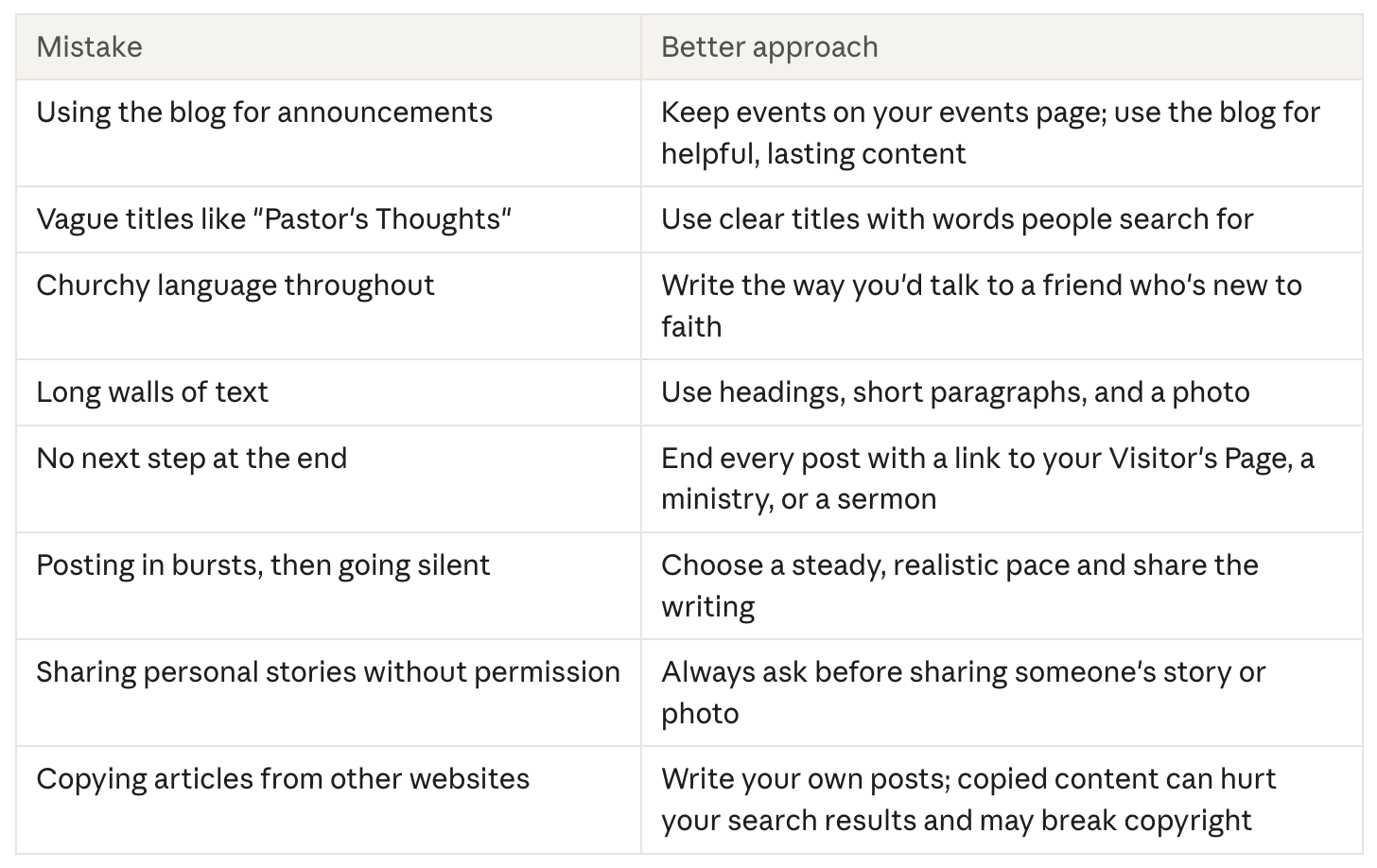
One last encouragement: your first posts don't have to be perfect. Every blog starts small. Write something helpful, publish it, share it, and keep going. A year from now, you'll have a library of pages quietly helping people find your church.
Your Five Action Steps for This Lesson
Collect 20 real questions. Ask your pastor, staff, and ministry leaders to write down questions people ask them about faith, life, and church. These become your first blog topics.
Turn your top five questions into titles. Rewrite each one using the everyday words someone would type into a search engine.
Recruit two or three writers. Find a few people besides your pastor who enjoy writing, and share the simple post template with them.
Choose your rhythm and plan three months. Decide how often you'll post (once or twice a month is plenty), and fill in a simple calendar with topics and writers for the next three months.
Publish your first post. Write one helpful post that answers a real question, add a photo with a short description, end with a link to your Visitor's Page, and share it on social media and in your newsletter.