Why a church needs a pathway, not just programs
A church grows mature disciples when it has a clear pathway, not just a full calendar. Many churches run good programs: Sunday school, a men's breakfast, a women's study, VBS, a fall festival. But when those programs stand alone, people drift from one event to the next without ever being led anywhere.
A program is an event with a start and an end; we measure it by attendance. A process, or pathway, is a route that moves a person from where they are toward maturity in Christ; we measure it by transformation.
This is the heart of the church's calling. Jesus sent us to make disciples and teach them to obey all He commanded (Matthew 28:19–20). Paul said leaders exist to equip the saints so the whole body grows up into Christ (Ephesians 4:11–16), and his aim was to present everyone mature in Christ (Colossians 1:28). Maturity is the goal, so the church needs a way to help people get there.
God gives the growth (1 Corinthians 3:6). A pathway does not replace the Holy Spirit. It simply makes our part intentional instead of accidental. Here are six steps any church can take to build one.
Step 1: Define what a mature disciple looks like
You cannot build a path until you know the destination. Before changing any ministry, the pastors and leaders should agree on a short, memorable description of a mature follower of Jesus.
Keep it to four or five marks that come straight from Scripture. For example, a mature disciple:
Loves God: worships, prays, and lives by God's Word (Matthew 22:37; 2 Timothy 3:16–17).
Loves the church: is committed to a community of believers and grows in relationship with them (Hebrews 10:24–25; Acts 2:42–47).
Is becoming like Christ: shows the fruit of the Spirit in character and choices (Galatians 5:22–23; Romans 8:29).
Serves others: uses spiritual gifts to build up the body (1 Peter 4:10).
Makes disciples: shares the gospel and invests in others' faith (2 Timothy 2:2).
Write it in plain words people can remember. Many churches turn the marks into a simple phrase, such as "Love God, Love People, Make Disciples." Whatever words you choose, this definition becomes the filter for every decision that follows.
Step 2: Map the stages of growth
People are at different places, so a pathway needs stages. Scripture itself speaks of milk before solid food (1 Corinthians 3:1–2) and of little children, young men, and fathers in the faith (1 John 2:12–14). Jesus moved His followers from "come and see" to "follow me" to "go and make disciples."
Most churches can work with four or five stages. Here is one common model to adapt:
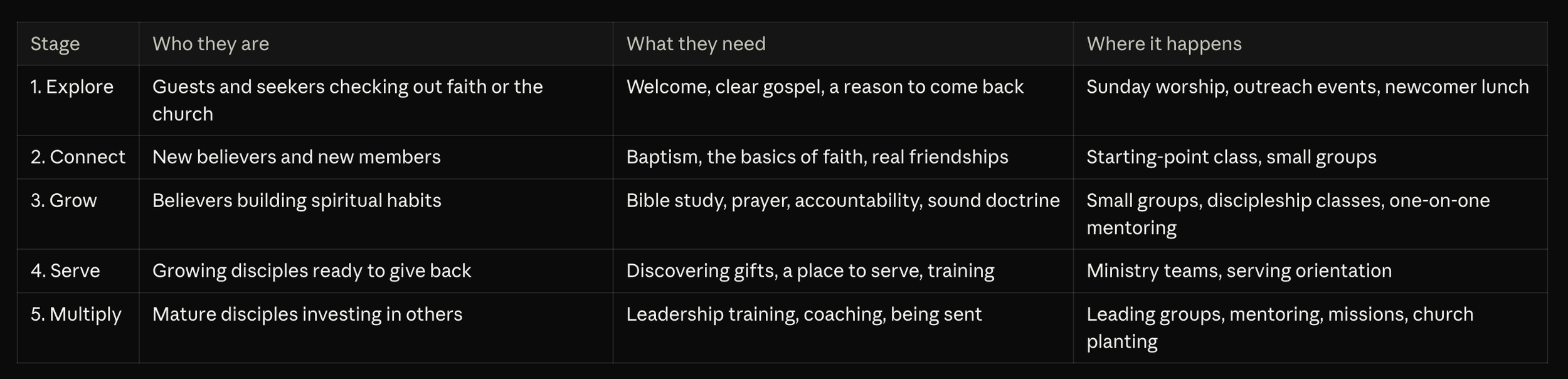
Give each stage a clear name your people will use. The labels matter less than the clarity: anyone should be able to say where they are and what comes next.
Step 3: Give every ministry a place on the pathway
With the stages mapped, look honestly at everything the church already does. This is where programs start becoming a process.
List every ministry, class, and event on the calendar, including the long-standing ones.
Ask four questions of each:
Which stage does this serve?
Is it helping people grow, or only keeping them busy?
Where does it lead people next?
Is it worth the volunteers, time, and money it takes?
Sort the results. Some ministries fit well; keep them and connect them. Some fit with changes; redesign them. Some fit no stage; thank the people who served and lovingly let them go.
Look for gaps. Often a church has plenty for stage 1 and stage 3 but nothing that helps people serve or multiply. Fill gaps before adding anything else.
The goal is one primary environment for each stage. A church that does a few things well, all pointing the same direction, will grow more disciples than one doing many things that point nowhere. Saying no to good things frees people and resources to say yes to the best things.
Step 4: Build clear next steps between stages
People rarely get stuck inside a stage; they get stuck between stages. A guest enjoys Sunday but never joins a group. A group member loves Bible study but never serves. Each gap needs an easy, obvious bridge.
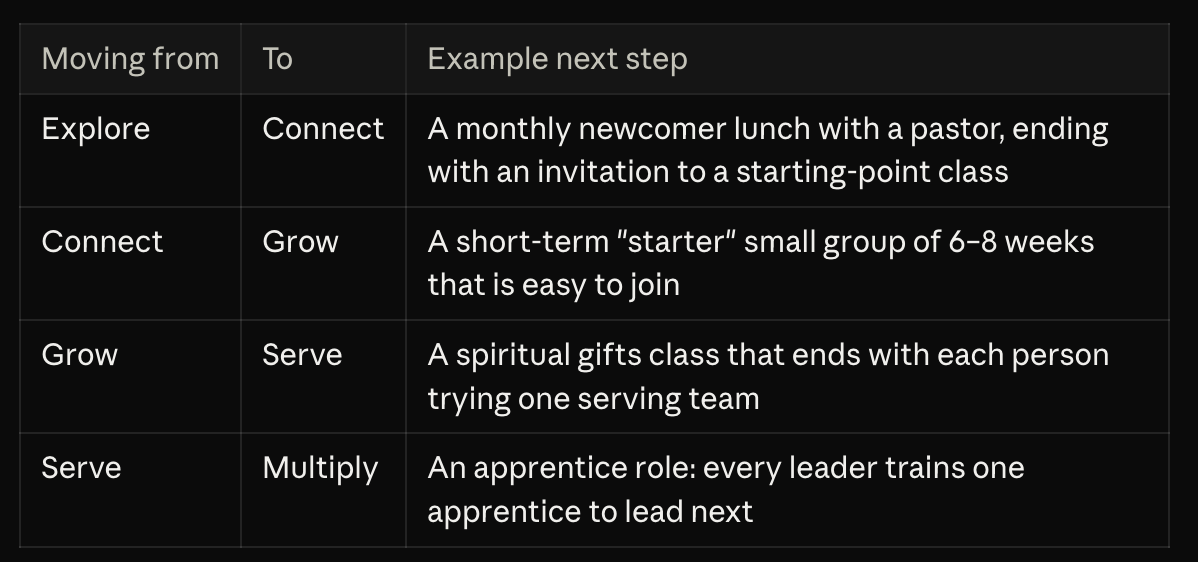
A good next step is:
Simple: one clear action, not a menu of options.
Short-term: a few weeks, not an open-ended commitment.
Personal: a real person invites them, rather than a bulletin announcement alone.
Repeated often: offered regularly so no one has to wait months to take it.
Every environment should end by pointing to the next one. From the pulpit, in every group, and on every team, leaders should regularly ask, "What is your next step?"
Step 5: Align leaders, language, and calendar
A pathway only works if the whole church walks it together. Alignment turns a plan on paper into a culture.
Leaders: Train every small-group leader, teacher, and team lead in the pathway. Their job shifts from running an event to guiding people to their next step. Ask each leader to know where their people are and to develop at least one apprentice.
Language: Use the same stage names everywhere: sermons, announcements, the website, the welcome desk, and children's and youth ministry. Consistent words help people find their way.
Preaching: Let the pulpit cast the vision. Preach on discipleship and maturity, share the pathway at least twice a year, and end messages with a clear next step.
Calendar: Plan the year around the pathway. Schedule next-step classes and group launches at regular, predictable times, and protect them from competing events.
Budget and staff: Put money and people where the pathway needs them most, especially in the gaps you found in Step 3.
Families: Help parents see the home as the first place of discipleship, with the church partnering alongside them (Deuteronomy 6:6–7).
Step 6: Measure movement and keep refining
What a church counts shows what it values. Keep counting attendance, but start counting movement along the pathway too.
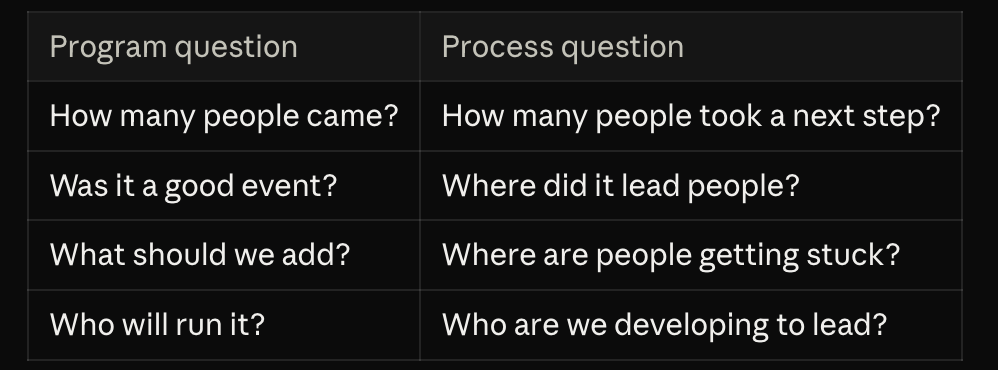
Simple numbers to track each quarter:
Guests who returned and joined a starting-point class
Baptisms and new members
Percentage of adults in a small group
Percentage of adults serving on a team
New leaders and apprentices trained
Numbers never tell the whole story, so gather stories too. Share testimonies of people who moved from one stage to the next; they show the congregation what growth looks like. Then review the pathway once a year as a leadership team and adjust what is not working.
Getting started: your first 90 days
Moving from program to process takes time, often a year or more. Go slowly, pray much, and bring people along. Here is a simple way for a leadership team to begin.
Days 1–30: Pray and define
Gather pastors and key leaders to pray and study what Scripture says about maturity
Write your definition of a mature disciple (Step 1)
Draft your stages and name them (Step 2)
Days 31–60: Evaluate and connect
List every ministry and place it on the pathway (Step 3)
Identify the biggest gap and the biggest place people get stuck
Design one clear next step to bridge that gap (Step 4)
Days 61–90: Launch and communicate
Train leaders in the pathway and the "What is your next step?" question (Step 5)
Present the pathway to the congregation in a sermon or vision Sunday
Launch your first next-step class or group
Choose the numbers you will track and set a date to review (Step 6)
A pathway is not a program with a new name. It is a shared conviction that every person in our church, wherever they are today, can take one more step toward Jesus. May we be a church that helps them take it, until we all grow up into maturity in Christ (Ephesians 4:13).