One Path, Many Footsteps
In the last lesson, we laid the foundation. We compared program-driven and process-driven churches, and you probably started picturing a simple path that helps people grow. That's exactly where we're headed.
But as soon as leaders start building a discipleship path, a good question usually comes up: "Won't a one-size-fits-all path leave some people out?" And it's a fair question. The new believer who just walked in the door is in a very different place than the retired deacon who's been teaching Sunday school for 30 years. A college student, a single mom working two jobs, and a couple with an empty nest won't all grow in the same way or at the same pace.
Here's the answer: you need both. You need a church-wide pathway that everyone shares, and you need individual options that help each person take their own next step. One gives your church unity and direction. The other gives each person room to grow in the way God made them. When the two work together, you get a church that's moving in the same direction without forcing everyone into the same mold.
Think of it like a family road trip. Everyone is in the same car, headed to the same place, on the same highway. But each person in that car is having their own experience of the journey. In this lesson, we'll look at both sides — the shared highway and the personal journey — and how to build them so they work hand in hand.
The Church-Wide Pathway: Where We're All Going
The church-wide pathway is the shared road everyone travels. It's the few simple steps — something like Connect, Grow, Serve, Multiply — that describe how anyone in your church moves toward maturity in Christ. It's the same for the teenager and the senior adult, the new believer and the long-time member.
Scripture gives us a clear picture of where that road leads. Paul describes the goal of the church's leaders this way:
"For the perfecting of the saints, for the work of the ministry, for the edifying of the body of Christ: Till we all come in the unity of the faith, and of the knowledge of the Son of God, unto a perfect man, unto the measure of the stature of the fulness of Christ." — Ephesians 4:12–13 (KJV)
Notice those words: till we all come. God's plan is for the whole church to grow up together into maturity. That's what a church-wide pathway does. It gives everyone a common destination and a common language.
A shared pathway gives your church some real gifts:
Unity. Everyone knows where the church is headed, so ministries pull in the same direction instead of competing.
Clarity. A guest can ask, "How do I grow here?" and get the same simple answer from anyone.
Focus. When a new idea comes along, you can ask, "Does this help people take a step on our pathway?"
Shared language. When the pastor, the youth leader, and the small group host all talk about "next steps," people start to own the journey.
Jesus gave His church one mission for all of us: "Go ye therefore, and teach all nations" (Matthew 28:19, KJV). The church-wide pathway is simply your church's clear, practical way of living out that mission together.
Individual Options: Each Person's Next Step
While the destination is the same for everyone, the journey isn't. God made each of us unique, and He meets each of us right where we are. That's why your pathway also needs individual options — different ways a person can take their next step based on their season of life, spiritual maturity, gifts, and schedule.
Paul's picture of the church as a body makes this beautifully clear:
"For as the body is one, and hath many members, and all the members of that one body, being many, are one body: so also is Christ." — 1 Corinthians 12:12 (KJV)
One body, many members. A hand doesn't grow the same way an eye does, and it doesn't serve the same way either. In the same way, one person's "Grow" step might be a weekly small group, while another's might be a one-on-one mentoring relationship or an online Bible study they can do after the kids are in bed.
Paul also shows us that discipleship is personal. He describes his own ministry like this:
"Warning every man, and teaching every man in all wisdom; that we may present every man perfect in Christ Jesus." — Colossians 1:28 (KJV)
Three times in one verse he says every man. Paul didn't just preach to crowds. He cared about each person's growth. Jesus even reminded us that growth comes in stages: "first the blade, then the ear, after that the full corn in the ear" (Mark 4:28, KJV). People grow at different speeds and in different seasons, and that's okay.
Individual options might include:
Different formats. Classes, small groups, one-on-one mentoring, online studies, or self-guided reading plans.
Different times. Sunday mornings, weeknights, lunch breaks, or anytime on-demand.
Different life stages. Options designed for students, young families, men, women, or senior adults.
Different spiritual starting points. A first step for someone exploring faith looks very different than a next step for a mature believer ready to lead.
Different gifts. Service opportunities that match how God has wired each person.
How the Two Work Together
If you want a model for blending a shared pathway with personal attention, look no further than Jesus. He ministered to the crowds, teaching thousands on hillsides. He sent out the seventy (Luke 10:1). He invested deeply in the twelve. And within the twelve, He often took Peter, James, and John aside for more personal time (Mark 9:2). Same mission, same message — but different levels of closeness depending on where people were and what they were ready for.
That's the balance we're after. The pathway is the what and the where. The individual options are the how and the when. Here's a quick way to see it:
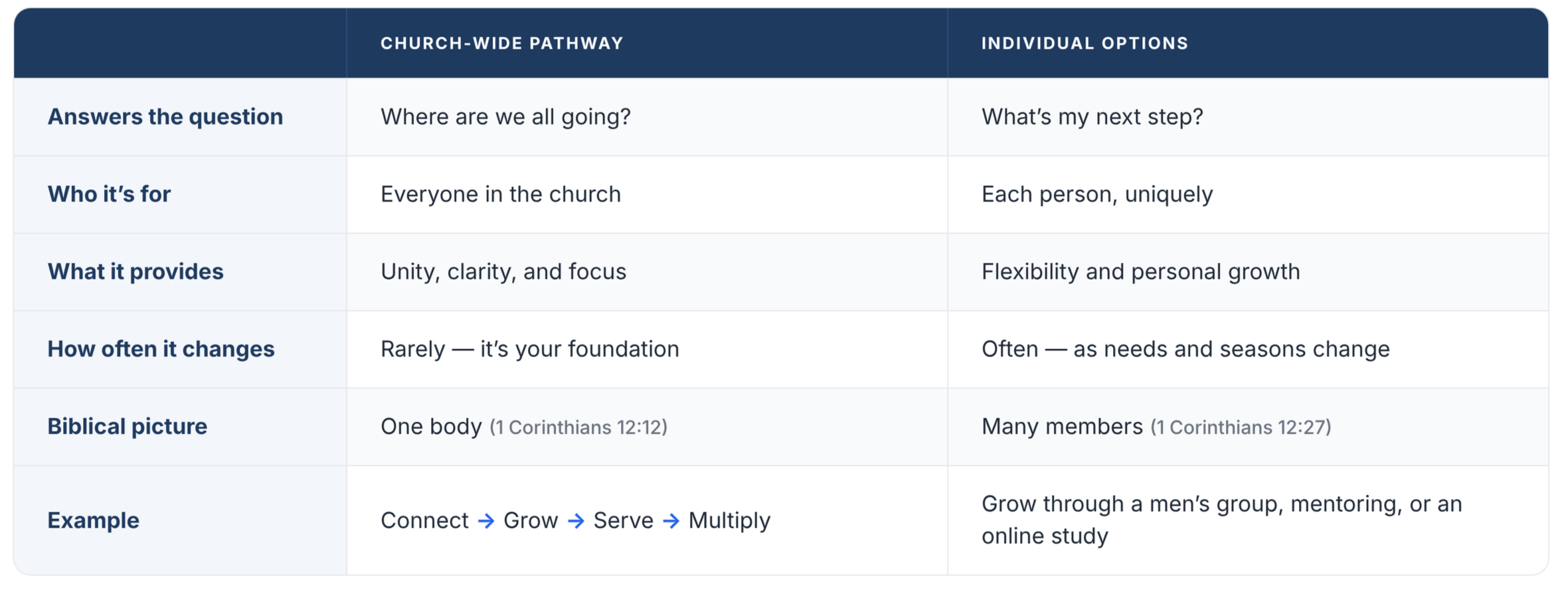
Here's the key: every individual option should clearly connect back to a step on the church-wide pathway. If an option doesn't help someone take a step on the shared path, it's probably just another program. Variety is a gift, but only when it's all heading in the same direction.
Best Practices for Building Individual Options
Now for the practical part. Offering individual options can quickly slide back into a program church if you aren't careful. Here are some guidelines to keep you on track:
Start with the pathway, not the options. Get your church-wide steps clear first. Then build options underneath each step.
Keep the list short. Two or three good options per step is plenty. Too many choices can overwhelm people and spread your leaders thin.
Make the next step obvious. For every option, people should know where it leads. A newcomers' class, for example, should always end with a clear invitation into a small group or serving team.
Have real conversations. Individual options work best when someone helps a person choose. Train leaders to sit down with people and ask, "Where are you right now, and what would help you take your next step?"
Use simple tools. A short spiritual growth assessment, a next-steps card, or a one-page pathway guide can help people see their options at a glance.
Review regularly. Once a year, look at each option and ask, "Is this still helping people move forward?" Keep what's working and lovingly retire what isn't.
As Peter reminds us, the goal is for each of us to "grow in grace, and in the knowledge of our Lord and Saviour Jesus Christ" (2 Peter 3:18, KJV). Your pathway and your options are simply tools to help that happen, one person at a time.
Action Steps
Before you move on to Lesson 5, work through these on your own or with your team:
Read and reflect. Read Ephesians 4:11–16 and 1 Corinthians 12:12–27. Write down what each passage teaches you about growing together and growing individually.
Draft your pathway steps. Using what you wrote in Lesson 3, sketch out three to five simple steps for your church-wide pathway. Give each step a short, memorable name.
Map your options. Go back to your ministry list. Next to each ministry, write which pathway step it helps people take. Note any steps that have no options and any that have too many.
Picture three people. Think of three real people in your church in very different seasons of life. For each one, ask, "What would their next step be, and do we offer a good option for it?"
Talk with one person. Sit down with someone this week and ask, "Where are you in your walk with God, and what would help you take your next step?" Notice what you learn.
Pray for every member. Like Paul, pray for each person by name if you can, asking God to help them grow.
You're building something that will serve your whole church and every person in it. See you in Lesson 5!