
Website Foundations
Welcome Back
Last time, we talked about the basic goals of a church website and what deserves your attention. Today we're going to step back and wrestle with a question that someone in your church has probably asked out loud: "Why do we even need a website? We've done just fine without one."
It's a fair question, and it deserves an honest answer. Maybe your church is small and everyone knows everyone. Maybe you have a Facebook page and that seems like enough. Maybe the last website someone built cost a lot of money and nobody ever updated it.
In this lesson, we'll make the case for why a website matters, why a good one matters even more, and why your website shouldn't be a glossy brochure sitting off to the side. Instead, it should be a real, living part of your church's ministry.
The Case for Having a Website at All
Let's start with a simple truth: people are looking for you online whether or not you're there. When someone hears about your church, gets invited to a funeral or wedding, or simply wonders whether there's a church nearby, the internet is where they go. If they don't find you, they'll find someone else, or they'll find nothing and give up.
"But we have a Facebook page." That's great, and you should keep it. Social media is a wonderful place for conversation and quick updates. But it has some real limits:
You don't own it. The platform controls what people see, can change the rules at any time, and decides who gets shown your posts.
Not everyone uses it. Plenty of people, young and old, don't have an account or rarely check it.
Important information gets buried. Your service times and beliefs get pushed down by last week's potluck photos.
It's harder to find in a search. A website is what typically shows up when someone searches for your church by name or location.
Think of it this way: social media is like chatting with folks on the sidewalk, while your website is your home. You want both, but only one of them is truly yours.
There's also a deeper reason. Churches have always met people where they are. The early church went to marketplaces and synagogues. Later generations used printing presses, radio, and television. Today, a huge part of people's lives happens on a screen. Having a website isn't about chasing trends. It's about being present where people already are.
Why Quality Matters
Here's where things get interesting. Having a website isn't quite enough. A poorly made or neglected website can actually do more harm than having no website at all.
Why? Because people read between the lines. Fairly or not, visitors make assumptions about your church based on what they see online. Consider what a struggling website quietly communicates:
Outdated events on the homepage say, "Nobody here is paying attention."
Broken links and missing pages say, "We don't really care about details."
Tiny text that's hard to read on a phone says, "This wasn't made with you in mind."
No photos of real people says, "We might not be very welcoming."
No clear service times says, "Figure it out yourself."
None of those messages are true about your church, but a visitor has no other way to know. Your website speaks for you when you aren't there to speak for yourself.
Now, quality doesn't mean expensive or flashy. A quality church website is simply clear, current, welcoming, and easy to use. That's it. A small country church with a simple three-page site that's accurate and warm can be far more effective than a big church with a slick, confusing site.
There's one more angle worth considering. Doing something with care is a way of honoring the people we serve. We clean the sanctuary before Sunday. We prepare the sermon. We greet people at the door with a smile. Taking care with your website is part of that same spirit of hospitality and excellence.
Brochure or Ministry?
This is the big idea of today's lesson, so let's take our time with it.
Many churches treat their website like a brochure. Someone builds it once, fills it with nice photos and a welcome message, and then it just sits there. It's separate from the real life of the church. It advertises the church, but it isn't really part of the church. It's a bit like a flyer taped to the outside of the building.
The problem with the brochure approach is that a brochure is frozen in time. The church keeps moving: new sermons get preached, new families arrive, ministries start and stop, prayer needs change. But the brochure stays the same. Before long, the website and the actual church are telling two different stories.
We want something different. We want your website to be an extension of your ministry, not an advertisement for it. That means the website is woven into the everyday life of your congregation. It reflects what's actually happening, it helps people take real next steps, and it serves your members just as much as it serves visitors.
Here's one way to picture it. A brochure talks about your church. A ministry website does the work of your church. It welcomes, informs, connects, teaches, and invites, the same things your people do on a Sunday morning.
When your website is truly part of the church, a few things naturally happen:
It stays current because it's tied to what's happening each week.
It feels authentic because it shows your real people and real ministries.
More people share responsibility for it, so it doesn't rest on one tired volunteer.
Members actually use it, which keeps everyone invested in its health.
What an Integrated Website Looks Like
So what does this look like in real life? Here's a side-by-side comparison to make it concrete.
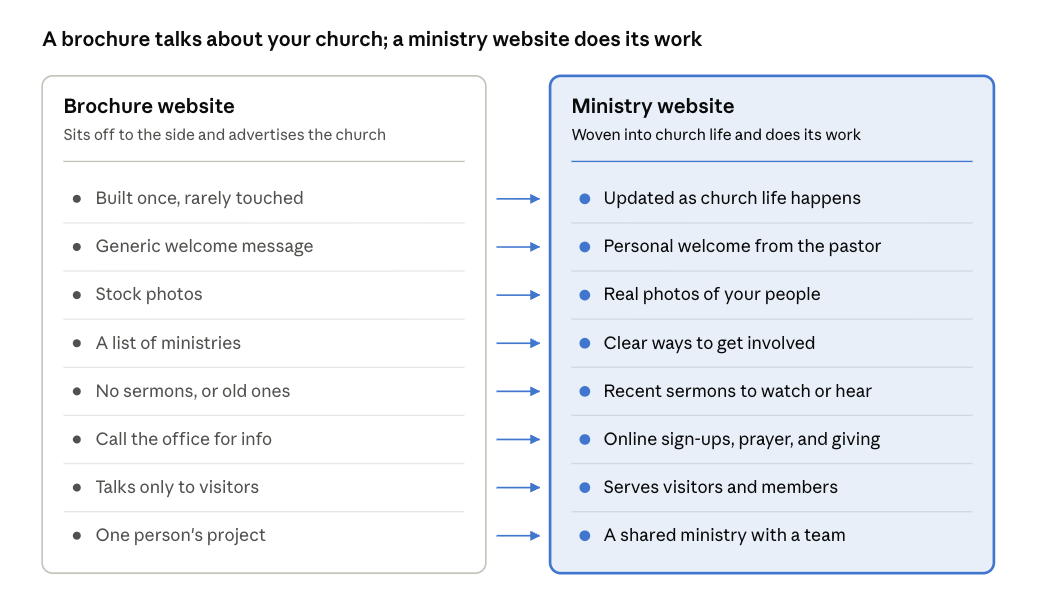
Each arrow is a step your church can take, one item at a time, from advertising the church to sharing in its ministry.
A helpful habit is to ask, after every major church event or announcement, "Does the website need to know about this?" When that question becomes second nature for your staff and leaders, your website stops being an afterthought and becomes part of how your church communicates.
Who Owns the Website?
If the website is part of the church's ministry, then it can't belong to just one person. Too many church websites fall apart because "Bob built it" and then Bob moved away, got busy, or forgot the password.
Instead, think of your website the way you think of any other ministry. It needs leadership support, a few dedicated people, and a clear plan. Your pastor and leaders should see it as part of the church's outreach and communication, not a technical chore handed off to whoever knows computers.
In practical terms, ownership means a few things. The church (not an individual) should own the website account and domain name. Logins should be stored somewhere safe that more than one leader can access. And there should be a simple understanding of who updates what, so nothing falls through the cracks. We'll get into the details later in the course, but it's worth planting that seed now.
Your Five Action Steps for This Lesson
Give your current online presence an honest checkup. Look at your website and social pages as if you were a stranger. Write down what each one is quietly communicating about your church, both good and bad.
Decide: brochure or ministry? Using the comparison table above, mark which column your current site (or your plans) mostly falls into. Circle two or three items from the ministry column you'd like to work toward first.
Talk with your pastor and leaders. Share the idea that the website is an extension of ministry, not an advertisement. Ask them to name one way the website could help with something the church is already doing.
Find out who owns what. Track down who holds the login for your website, domain name, and social media accounts. Make sure the church owns them and that at least two leaders can access them.
Start a "website should know" list. For the next two weeks, jot down every announcement, event, sermon, and ministry update that happens. This list will show you what an integrated website needs to keep up with.