Giving Growth a Name
In the last lesson, you took a hard, honest look at your church. You counted your people, inventoried your ministries, mapped your structure, and named your top strengths and weaknesses. That was real work, and I'm proud of you for doing it.
Now we're going to start building. And the first thing we'll build is the backbone of your whole process: the stages of spiritual growth. These are the few simple phases that describe how a person grows from not knowing Jesus at all to becoming a mature believer who helps others grow too.
Why start here? Because you can't build a path until you know where the stops are. Right now, if you asked ten people in your church, "What does it look like to grow as a Christian here?" you'd probably get ten different answers. Clear, named stages fix that. They give everyone — pastors, leaders, volunteers, and members — the same picture and the same language.
And don't underestimate the power of a good name. When stages have simple, memorable names, people start using them. A small group leader says, "I think Sarah's ready to move from Grow to Serve." A new member looks at the card in their hand and says, "I'm in the Connect stage." Suddenly, growth isn't a vague idea anymore. It's something people can see, talk about, and take steps toward.
Growth Happens in Stages
The idea of spiritual stages isn't something we made up for church planning. It's all through Scripture.
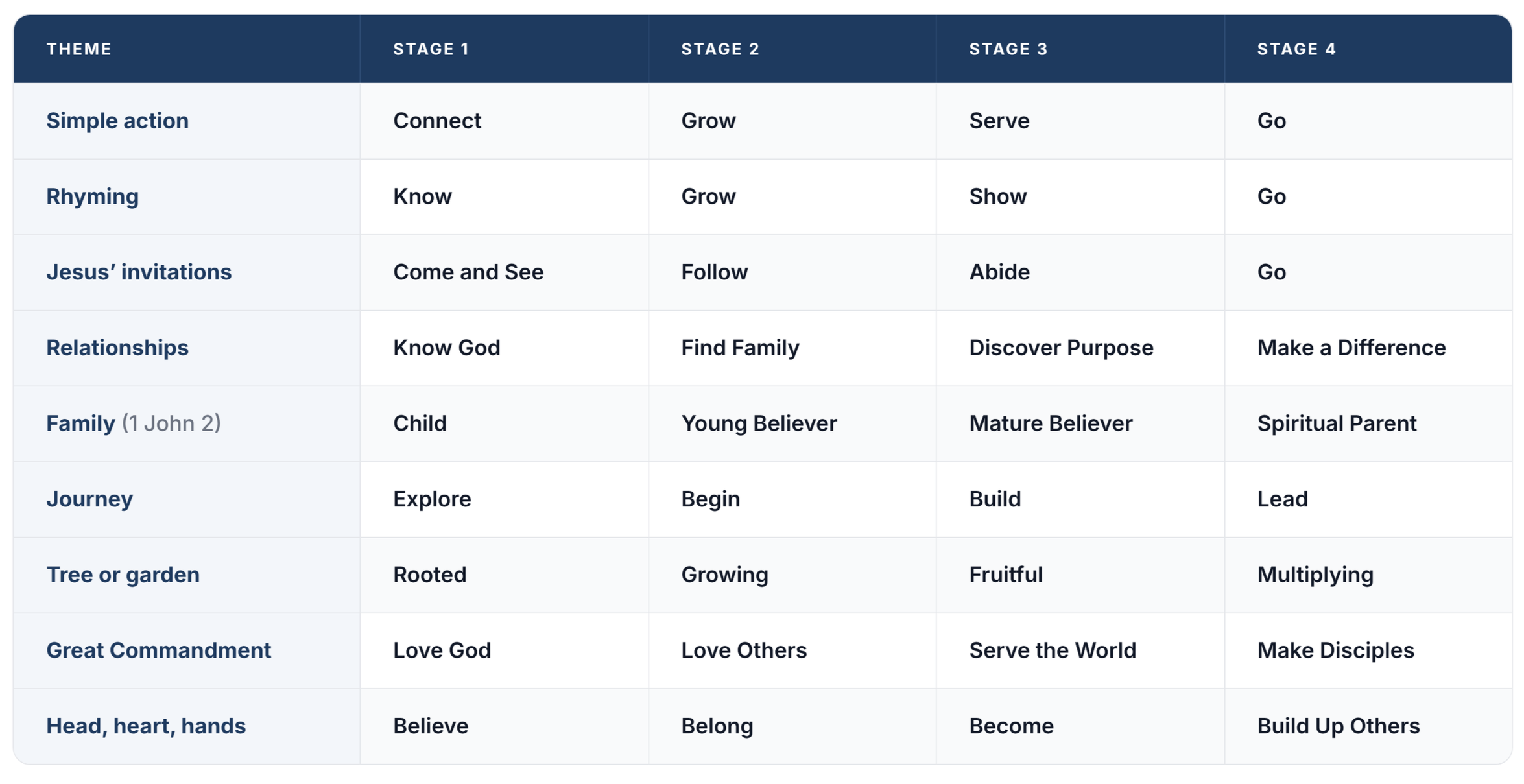
The apostle John wrote to believers at different points in their journey: "I write unto you, little children… I write unto you, young men… I write unto you, fathers" (1 John 2:12–14, KJV). He recognized that some were brand new in the faith, some were growing strong, and some had walked with God a long time.
Paul made the same point when he told the Corinthians, "I have fed you with milk, and not with meat: for hitherto ye were not able to bear it" (1 Corinthians 3:2, KJV). The writer of Hebrews said something similar, noting that solid food "belongeth to them that are of full age" (Hebrews 5:14, KJV). Different stages need different kinds of feeding.
Even Jesus' invitations followed a pattern. He started with "Come and see" (John 1:39). Then came "Follow me, and I will make you fishers of men" (Matthew 4:19). Later He taught, "Abide in me" (John 15:4). And finally, He sent them out: "Go ye therefore, and teach all nations" (Matthew 28:19). Each invitation built on the last, moving His followers from curiosity to commitment to multiplication.
So when you name your stages, you're not inventing something new. You're putting words to the way God has always grown His people.
What Makes a Good Stage
A stage is more than a catchy word. Each one should have three parts:
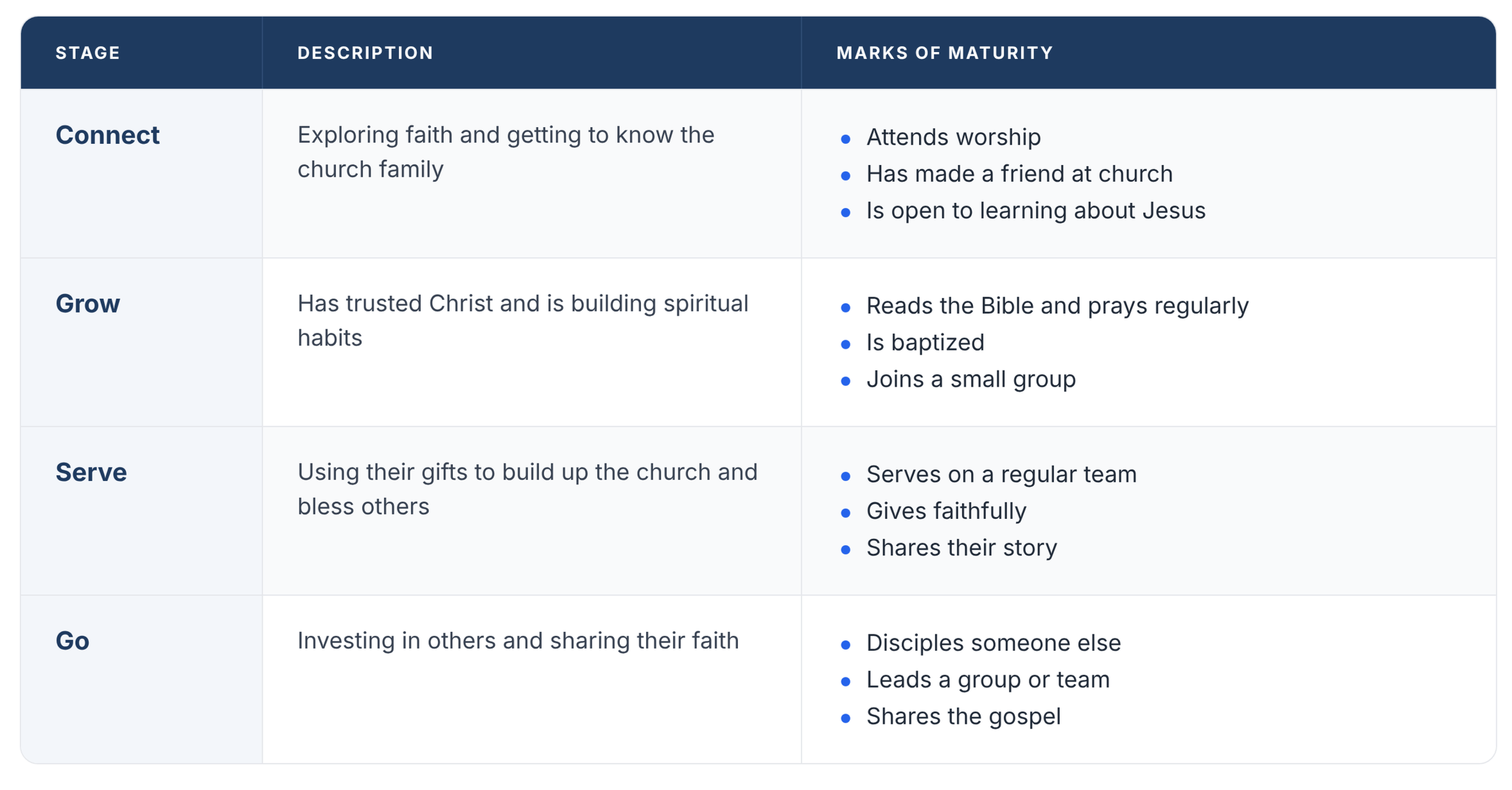
A simple description. One or two sentences about where a person is spiritually at this stage. For example: "Exploring faith and getting connected to the church family."
Marks of maturity. A few signs that show someone is growing in this stage. These should be things you can actually see, like "attends worship regularly" or "has a daily time in God's Word."
A clear next step. What helps a person move to the next stage? This is where your ministries come in.
When it comes to naming your stages, keep these tips in mind:
Keep it to three to five stages. Fewer than three is too vague. More than five is hard to remember.
Make the names short. One or two words each is ideal. If people can't remember them, they won't use them.
Use action words when you can. Words like connect, grow, and serve invite people to do something.
Consider a pattern. Rhyming, alliteration, or a theme (like a journey or a tree) makes names stick.
Root them in Scripture. Names drawn from the Bible carry weight and give you a natural teaching moment.
Fit your church. A rural church, a downtown church, and a college church might each choose different words. Pick names that sound like your people.
Idea Bank: Ways to Name Your Stages
Here are some naming sets to get your creative juices flowing. Feel free to borrow one, mix and match, or use them as a springboard for something completely your own.
A Worked Example
Here's what one set looks like when you fill in all three parts:
How to Create Yours
Ready to build your own? Here's a simple process you can follow, on your own or with your team:
Start with the end. Pull out the description of a disciple you wrote in Lesson 3 and your personal vision from Lesson 5. What does a mature believer look like in your church? That's your final stage.
Work backward. Ask, "What has to happen right before someone gets there?" Keep asking until you reach the very first step a guest or seeker takes.
Group the steps into stages. You'll probably end up with a long list of milestones. Cluster them into three to five natural phases.
Brainstorm names. Spend 15 minutes throwing out as many names as you can, with no judging allowed. Then narrow down to your two or three favorite sets.
Fill in the three parts. For each stage, write a description, three or four marks of maturity, and a next step.
Test it out loud. Explain your stages to a few people who weren't in the room. Can they remember them? Do they make sense? Do people see themselves in them?
Refine and pray. Make changes based on what you heard, and ask God to confirm the direction.
One more thing: don't expect perfection on the first try. Your stages will get sharper as you use them. The goal right now is a clear, solid draft you can build on.
Action Steps
Before you move on to Lesson 8, work through these on your own or with your team:
Study the stages in Scripture. Read 1 John 2:12–14 and 1 Corinthians 3:1–3. Write down what each passage teaches about how believers grow.
Define the finish line. Write three to five sentences describing a mature, multiplying disciple in your church.
Work backward. List every milestone between a first-time guest and that mature disciple. Then group them into three to five stages.
Brainstorm names. Use the idea bank for inspiration and come up with at least three possible naming sets. Pick a favorite.
Build your stage chart. Create a table like the worked example, with a description, marks of maturity, and next step for each stage.
Test it with five people. Share your stages with five people outside your planning team. Ask them which stage they think they're in and why.
Pray over your people. Look at your stages and think of one person in each one. Pray for their next step by name.
Once you've named your stages, you've given your church a shared map for growth. In the next lesson, we'll start connecting your ministries to that map. See you in Lesson 8!