Looking Inward — What Are You Really Working With?
Welcome to the Foundation Section
Welcome to Section 2! In the first section, you caught the vision. You know what a process church looks like, why it matters, and what you're hoping to see in your own church. That was the dreaming part. Now it's time to grab a shovel.
This section is all about building a real foundation. Not more theory — real, practical work you can do with your own church, your own people, and your own calendar. And every good foundation starts the same way: by finding out exactly what kind of ground you're building on.
That's what this lesson is about. Before you can build a pathway, you need an honest picture of where your church is right now. What's working? What isn't? Who's actually here? How do decisions really get made? What resources do you have to work with?
Nehemiah shows us how this is done. When he arrived in Jerusalem with a God-given vision to rebuild the walls, he didn't start by calling a big meeting or handing out tools. Instead, he went out at night and quietly inspected the walls himself. Scripture says he "viewed the walls of Jerusalem, which were broken down, and the gates thereof were consumed with fire" (Nehemiah 2:13, KJV). He saw the damage with his own eyes. Only after that honest look did he gather the people and say, "Let us build."
That's your job in this lesson. Walk the walls of your church. Look honestly at what's strong, what's broken, and what you have to work with.
Ground Rules for an Honest Look
Taking an honest look at your church can feel a little scary. Nobody enjoys finding out that a beloved ministry isn't bearing much fruit. But remember, the goal here isn't to judge or blame. It's to see clearly so you can build wisely. As Lamentations 3:40 puts it, "Let us search and try our ways, and turn again to the LORD" (KJV).
Keep these ground rules in mind as you work:
Facts first, feelings second. Use real numbers wherever you can. "I feel like our small groups are full" isn't the same as "42 adults are in a small group."
No sacred cows. Every ministry, structure, and tradition goes on the table. Looking at something isn't the same as cutting it.
Celebrate the good. Your church has real strengths. Name them! You'll build on them later.
Assume the best. Every program was started by someone who loved God and loved people. Honor that, even when something needs to change.
Get more than one view. If you can, have a few people fill this out separately, then compare. You'll be surprised what others see that you don't.
Grab your course notebook or shared document. The tables below are designed to be filled in, so feel free to copy them into your notes.
Step 1: Your People
Start with the people God has entrusted to you. Pull your attendance records, small group rosters, volunteer lists, and membership data. Use averages from the last 12 months so one big Sunday or one snowy weekend doesn't throw things off.
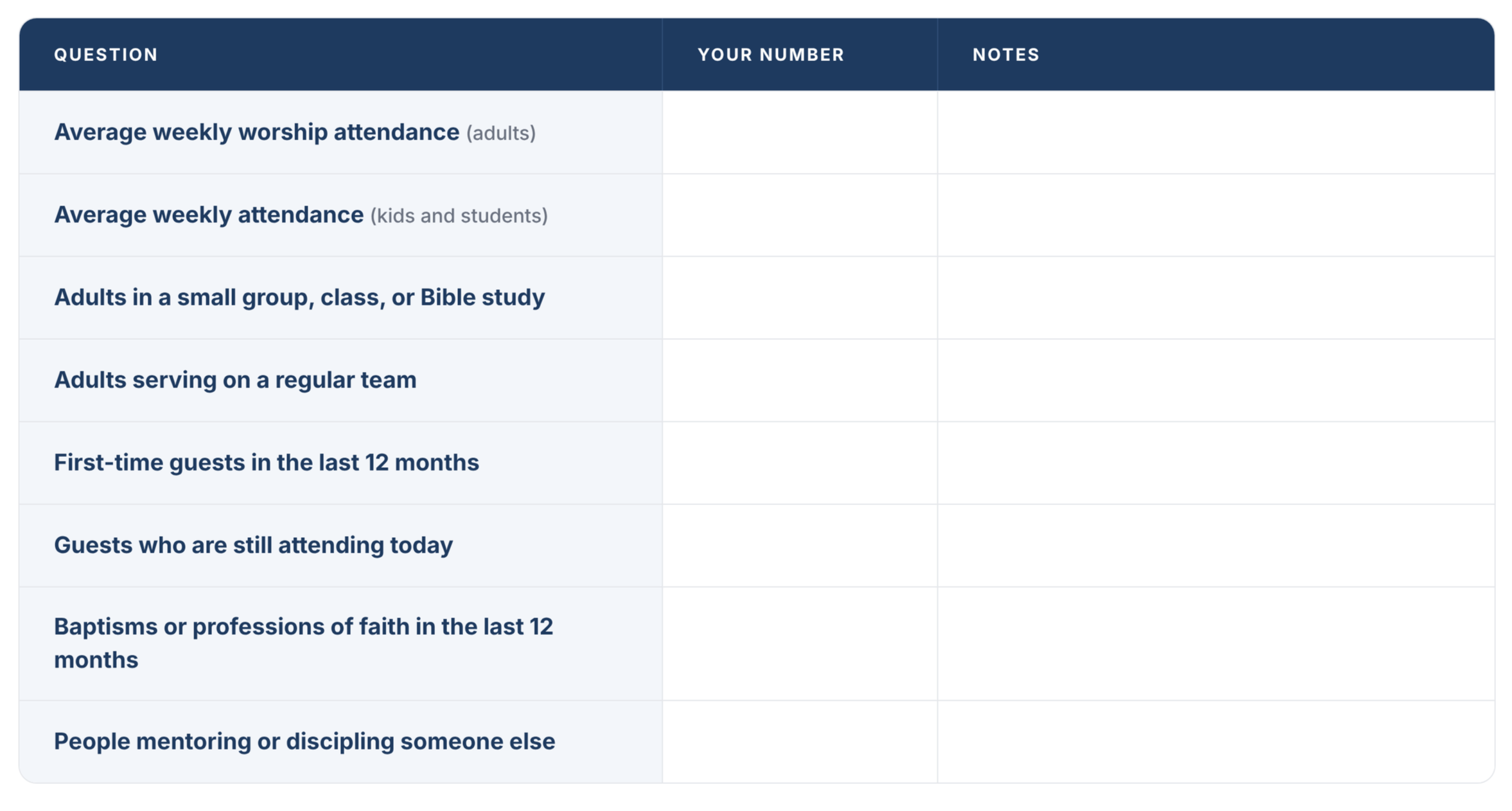
Once you've filled it in, step back and ask a few questions:
What percentage of your worship attendance is also in a group? Serving?
Where do the numbers drop off the most? That's often where your pathway is weakest.
What age groups or life stages are strong? Which are missing?
How many guests are actually sticking? If the answer is "not many," your first step may need some attention.
Step 2: Your Ministries
In Lesson 1, you made a list of every ministry, program, and event your church runs. Now it's time to dig deeper. For each one, fill in a row of the inventory below. Be honest, especially in the last two columns.
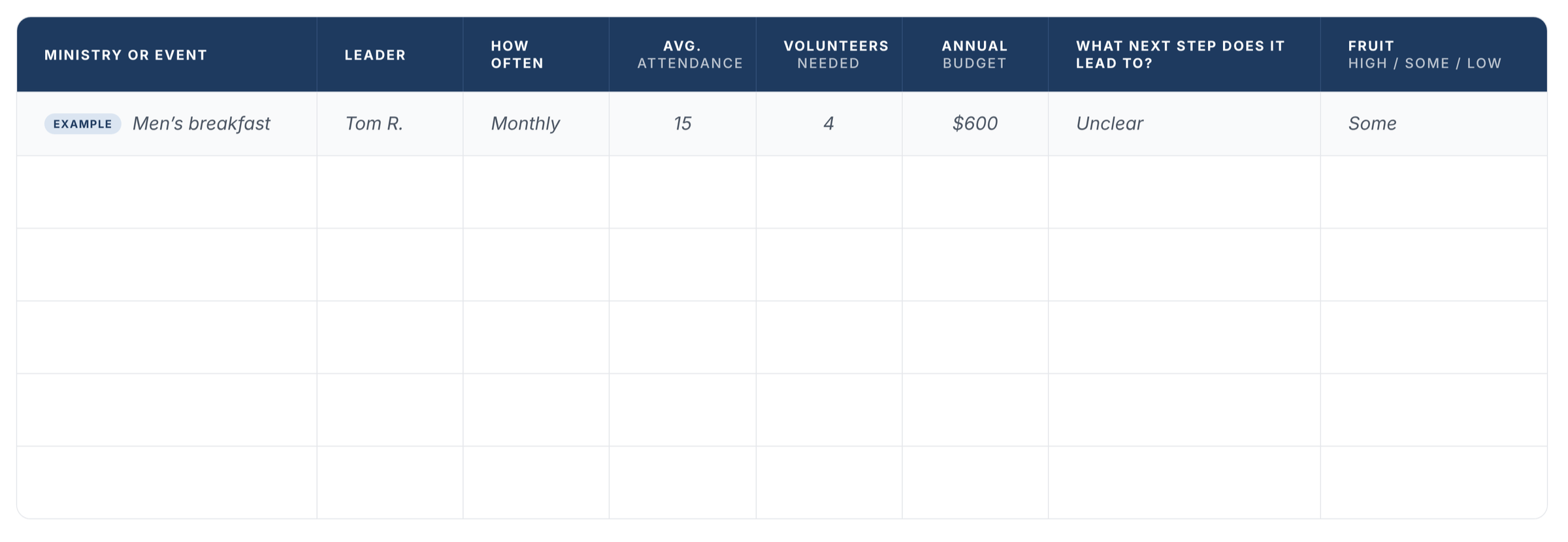
When you're done, look for patterns:
How many ministries have a clear next step? Those are already acting like part of a process.
Which ones take the most volunteers or money? Are they also the ones bearing the most fruit?
Where is there overlap? Two or three ministries may be trying to do the same thing for the same people.
What's missing? You may find a step in your pathway, like serving or multiplying, that has almost nothing supporting it.
Don't make any decisions yet. Right now you're just gathering the facts.
Step 3: Your Structure
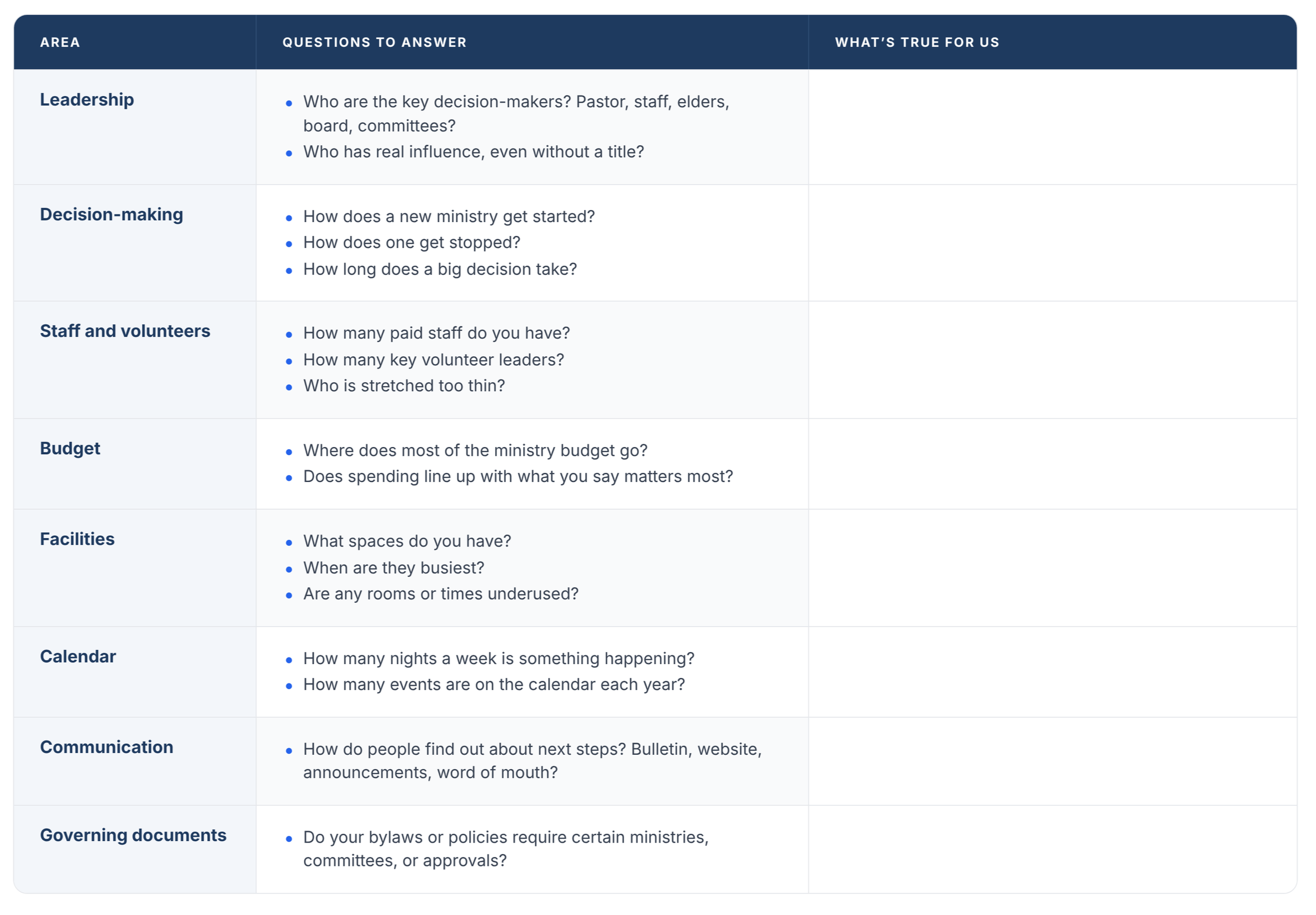
Every church has a structure, whether it's written down or not. It's the way decisions get made, money gets spent, people get placed, and the calendar gets filled. Your structure will either help the shift to process or quietly fight against it, so it's worth understanding well.
Work through each area below and jot down what's true today.
This step often brings the biggest surprises. You may discover that changing one ministry needs a vote from three committees, or that most of your budget is tied up in a single annual event. That's not bad news. It's just good information. Now you know what you're working with.
Step 4: Your Strengths and Weaknesses
Now that you have the facts, it's time to step back and see the big picture. In Revelation 2 and 3, Jesus speaks to seven churches. To most of them, He starts by naming what they're doing well — "I know thy works, and thy labour, and thy patience" (Revelation 2:2, KJV) — and then He lovingly names what needs to change. That's a great model for us.
Use these questions to name your church's strengths and weaknesses:
Strengths — what's working?
What does your church do better than almost anyone around you?
Where do you see real life change happening?
What do guests and members say they love most about your church?
Which leaders and ministries are already thinking in terms of next steps?
Weaknesses — what's holding you back?
Where do people get stuck or drop off?
What takes a lot of time, money, or energy without much fruit?
What would a guest find confusing about how to get involved?
What parts of your structure slow down good decisions?
When you've answered these, pick your top three strengths and your top three weaknesses. Write them in one place. These six items will be a big part of how you build your pathway in the lessons ahead. Your strengths are what you'll build on. Your weaknesses show you where to start.
Action Steps
This lesson is mostly action, so give yourself a week or two to work through it. Before moving on to Lesson 7:
Gather your data. Collect attendance records, group rosters, volunteer lists, the budget, and the church calendar for the last 12 months.
Complete the people snapshot. Fill in every row of the Step 1 table and answer the follow-up questions.
Finish your ministry inventory. Add a row for every ministry and event on your list from Lesson 1. Don't skip the "next step" and "fruit" columns.
Map your structure. Fill in the Step 3 table. If you're not sure how something works, ask someone who's been around a while.
Name your top three strengths and weaknesses. Write them on a single page and keep it in your course notebook.
Compare notes. If you're working with a team, have each person complete the assessment on their own first. Then meet to compare answers and agree on a shared picture.
Walk the walls in prayer. Like Nehemiah, take a quiet walk through your church building. Pray in each room for the people and ministries that meet there.
Remember, an honest look isn't a verdict on your church. It's a starting point. God already knows exactly where your church is, and He's ready to meet you there. See you in Lesson 7!