You Can't Measure the Heart, But You Can See Change
You've built a lot: stages, checkpoints, personal growth plans, a seven-day process, and transformed and new ministries. Now comes a question every process church eventually asks: "How do we know it's working? How do we know people are actually growing?"
Let's start with an honest admission. You can't measure someone's heart. Only God can do that. When Samuel went looking for Israel's next king, God told him, "man looketh on the outward appearance, but the LORD looketh on the heart" (1 Samuel 16:7, KJV). No survey, spreadsheet, or checklist can tell you exactly how close someone is to Jesus.
So what can you measure? Change.
Jesus said, "by their fruits ye shall know them" (Matthew 7:20, KJV). You can't see a root growing underground, but you can see the fruit on the branch. In the same way, you can't see spiritual growth directly, but you can see what it produces: new habits, deeper relationships, changed attitudes, and a growing desire to serve and help others. And when you look at those things over time, you can see whether someone is moving forward.
That's the big idea of this lesson. Measuring Christian maturity isn't about grading people. It's about noticing change, celebrating it, and helping people take their next step.
Four Areas of Change to Watch
To see growth clearly, look for change in four areas. Together, they give you a much fuller picture than attendance alone ever could.
1. Practices: what someone does. These are the habits of a growing believer: reading the Bible, praying, worshiping, giving, and gathering with other believers. They're the easiest to see and track. Is someone reading Scripture more often than they did six months ago? Did they start giving for the first time?
2. Relationships: who they're connected to. Growth almost always happens in relationship. Is this person connected to a group? Do they have friends at church who know them well? Do they have someone guiding them, and are they starting to guide anyone else?
3. Character: who they're becoming. This is the heart of maturity, and it's the hardest to measure. Paul describes it as the fruit of the Spirit: "love, joy, peace, longsuffering, gentleness, goodness, faith, meekness, temperance" (Galatians 5:22–23, KJV). You can't put a number on love, but you and the person can notice it growing. Are they more patient with their kids? Quicker to forgive? Less anxious?
4. Movement: where they're going. This is about your process. Has the person reached a new checkpoint? Taken a next step? Moved from one stage to the next? Movement shows that the process is actually working.
No single area tells the whole story. Someone can be at church every week (practices) but have no real friendships (relationships). Someone can be serving faithfully (movement) but struggling deeply with bitterness (character). Looking at all four helps you see the whole person.
How to Decide Which Stage Someone Is In
Placing someone in a stage isn't an exact science, and it doesn't need to be. The goal is to find the best fit so you can help them take a good next step. Use three sources of information together:
The marks of maturity. Go back to the marks you wrote for each stage in Lesson 7. Which stage's marks describe this person best right now?
The checkpoints. Look at the last checkpoint they reached (from Lesson 11). That's usually a strong clue about where they are.
The conversation. During a next-step conversation (from Lesson 12), ask them where they think they are. People often know better than we do.
Here's a simple placement guide using the Connect, Grow, Serve, Go stages:
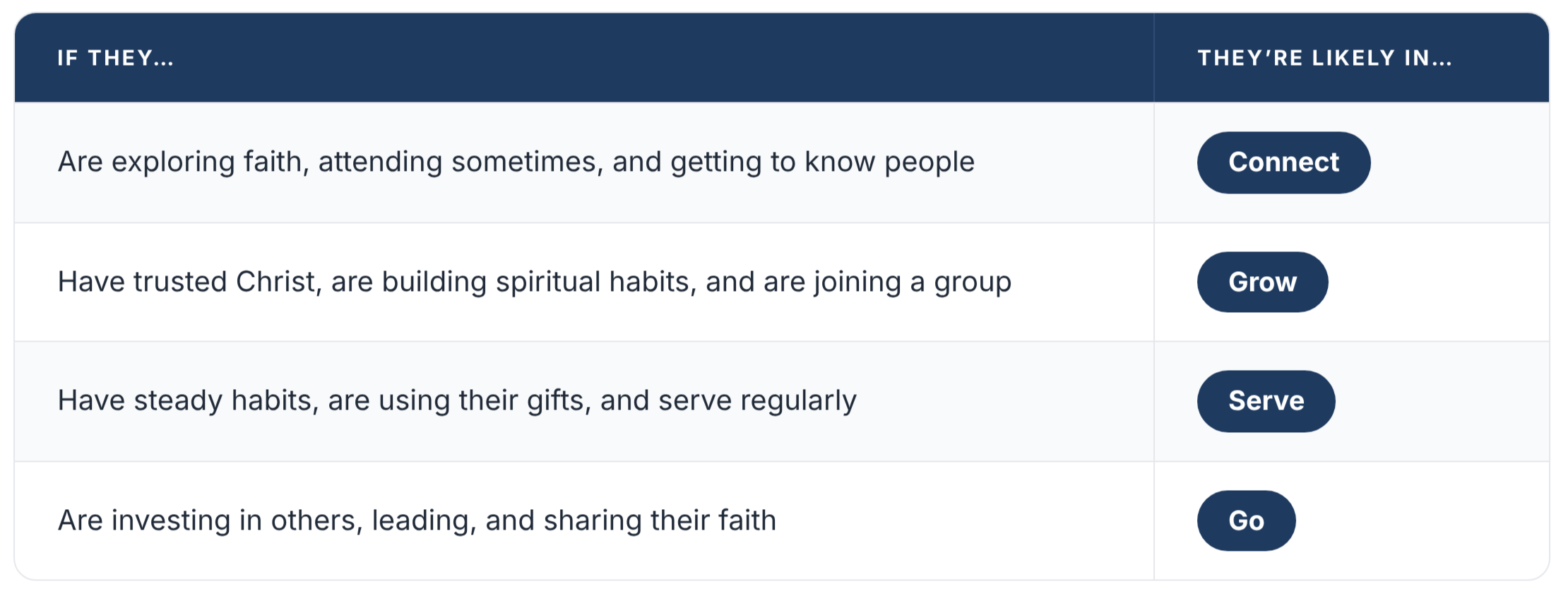
A few tips:
Look for the pattern, not one detail. Someone might serve on a team but still be brand new in their faith. Go by the overall picture.
When in doubt, choose the earlier stage. It's better to offer a next step that feels easy than one that feels overwhelming.
Remember that stages can shift. A hard season like grief, illness, or a crisis of faith can move someone back a stage for a time. That's okay. Meet them where they are.
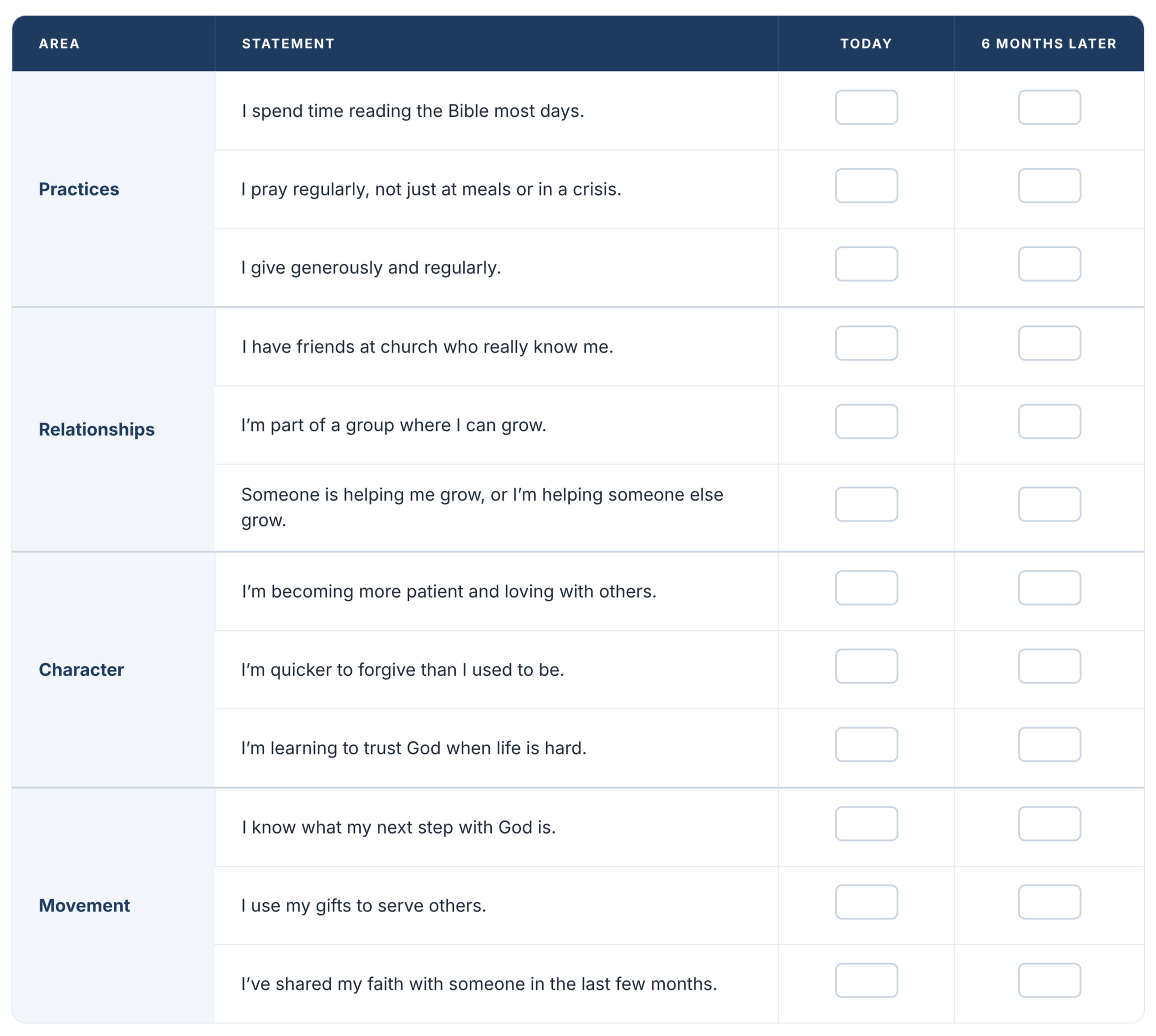
A Simple Growth Self-Assessment
One of the best ways to measure change is to let people rate themselves, then ask again later. A short self-assessment helps people reflect on their own growth and gives you a baseline to compare against. Keep it short so people actually fill it out.
Ask people to rate each statement from 1 (not at all true of me) to 5 (very true of me):
Add two open-ended questions at the end:
"What's one way you've seen God at work in your life recently?"
"Where do you feel stuck?"
The answers to these questions often tell you more than all the numbers combined.
A few tips:
Look for the pattern, not one detail. Someone might serve on a team but still be brand new in their faith. Go by the overall picture.
When in doubt, choose the earlier stage. It's better to offer a next step that feels easy than one that feels overwhelming.
Remember that stages can shift. A hard season like grief, illness, or a crisis of faith can move someone back a stage for a time. That's okay. Meet them where they are.
Measuring Change Over Time
Remember, a single snapshot doesn't tell you much. Growth only shows up when you compare then to now. That's why the key is to measure the same things at regular intervals.
For Each Person
Set a baseline. Have each person complete the self-assessment and note their current stage and last checkpoint. This becomes their starting point.
Check in every six months. Have them retake the assessment, ideally as part of a next-step conversation. Compare the two side by side and talk about what's changed.
Celebrate any movement. A jump from 2 to 3 on "I pray regularly" is real growth. Name it and thank God for it.
Notice the stories. Write down what people share about how God is working. Stories of change are some of your best measurements.
For the Whole Church
Add up what you're learning across your church to see whether the process is working. Track a few key numbers every quarter:
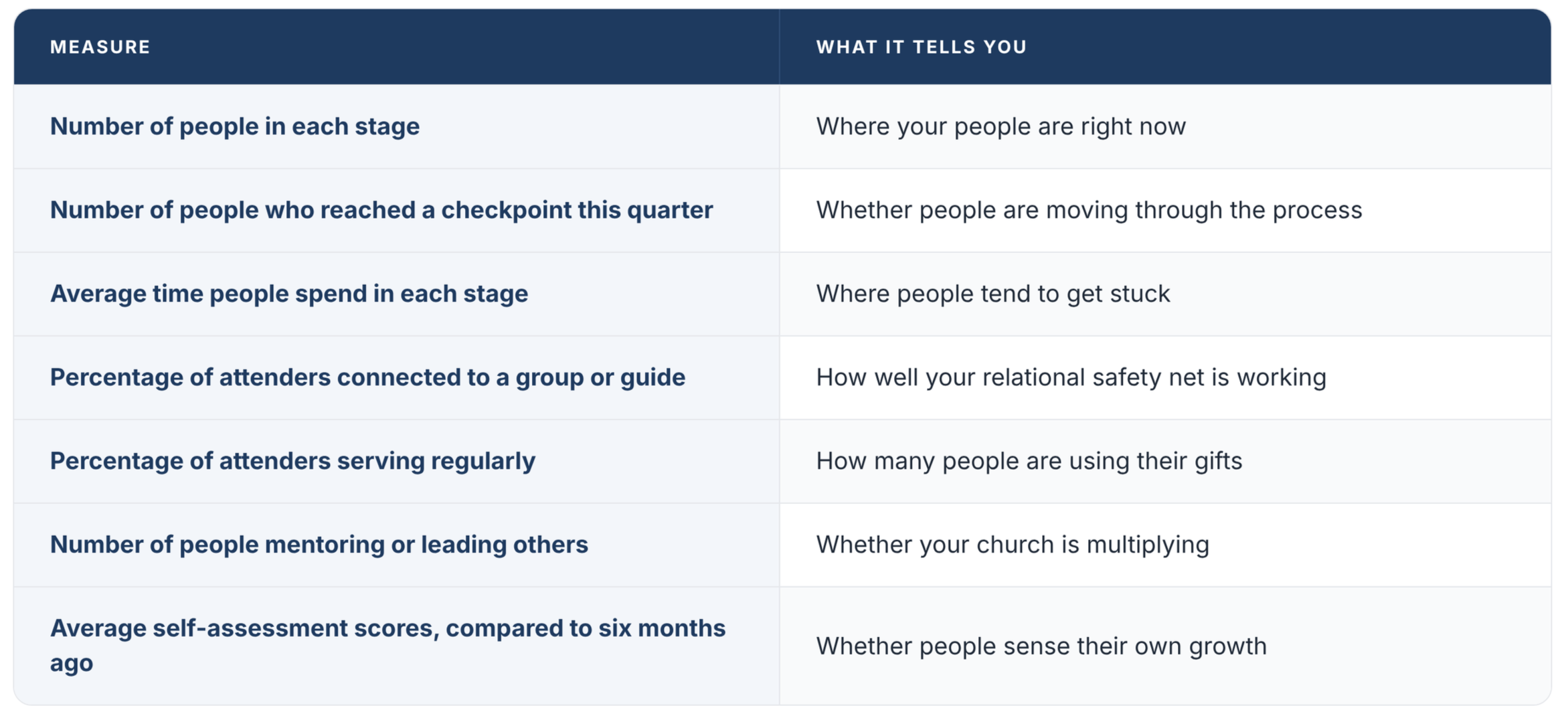
When you look at these numbers over a year or two, you'll start to see real patterns. That's when you'll know whether your process is truly producing change.
Measuring With Grace
Measurement is a tool, and like any tool, it can help or harm depending on how you use it. Keep these cautions in mind:
Never use measurements to shame. Numbers should start conversations, not end them. No one should ever feel like a failure because of a score.
Keep personal information private. Individual assessments should only be seen by the person and their guide. Share church-wide totals, never individual results.
Don't confuse activity with maturity. Someone can check every box and still be far from God. Someone else can be struggling to show up and still be growing deeply. Let the numbers point you to people, then listen to them.
Remember who brings the growth. Paul said, "neither is he that planteth any thing, neither he that watereth; but God that giveth the increase" (1 Corinthians 3:7, KJV). We measure to steward the process well, but God is the one who makes people grow.
Look for direction, not perfection. The most important question isn't "How mature is this person?" It's "Are they moving toward Jesus?"
Action Steps
Before you move on to Lesson 16, work through these on your own or with your team:
Read Galatians 5:16–26 and Matthew 7:15–20. Write down what these passages teach about recognizing spiritual growth by its fruit.
Customize the self-assessment. Adapt the statements to match your stages and marks of maturity. Keep it to 15 statements or fewer.
Take it yourself first. Complete the self-assessment honestly and save your answers. You'll retake it in six months.
Create your placement guide. Build a simple "If they… they're likely in…" table for your own stages.
Set a baseline with your leaders. Have your leadership team take the assessment and identify their own stages.
Choose your church-wide measures. Pick four or five measures from the table to track every quarter, and decide who will track them.
Put the check-ins on the calendar. Schedule your first quarterly review and your six-month reassessment.
Collect three stories of change. Ask three people how God has changed them over the last year, and write their stories down.
You can't measure the heart, but you can notice and celebrate change. And when you do, people grow. See you in Lesson 16!