Same Words, Different Pictures
Look how far you've come. You've caught the vision, laid the foundation, and developed a real process: stages, checkpoints, personal growth plans, a seven-day flow, transformed ministries, and a way to measure change. Now it's time to make that process part of your church's everyday culture. And one of the most powerful places to start is with something you use every single day: your words.
Here's a little experiment. Ask five people in your church, "What does it mean to be involved here?" One might say, "Coming every Sunday." Another might say, "Serving on a committee." A third might say, "Being in a small group." Same word, five different pictures.
That happens with all kinds of church words: member, growth, ministry, discipleship, commitment, success. We use them all the time and assume everyone means the same thing. But they often don't. And when people carry different pictures in their heads, they head in different directions, even when they're using the exact same words.
In a program church, most of our everyday language points to programs: events, attendance, and activities. If you want to become a process church, your language has to change too. In this lesson, we'll look at the words your church uses, define them clearly, and start speaking the language of process.
Why Shared Language Matters
Words shape the way people think and act. If the language around your church still points to programs, people will keep thinking in programs, no matter how good your new process looks on paper.
Paul understood how important shared language is. He urged the church in Corinth, "that ye all speak the same thing, and that there be no divisions among you; but that ye be perfectly joined together in the same mind and in the same judgment" (1 Corinthians 1:10, KJV). Speaking the same thing helps a church move as one.
He also warned about unclear words: "For if the trumpet give an uncertain sound, who shall prepare himself to the battle? So likewise ye, except ye utter by the tongue words easy to be understood, how shall it be known what is spoken?" (1 Corinthians 14:8–9, KJV). When the trumpet is fuzzy, nobody knows which way to march.
And when Ezra read God's Word to the people after they returned from exile, the leaders didn't just read the words. They "gave the sense, and caused them to understand the reading" (Nehemiah 8:8, KJV). They made sure everyone understood what the words meant.
That's our goal: clear words, shared meaning, and a church that moves together in the same direction.
Words We Assume Everyone Understands
Here are some common church words that often mean very different things to different people. Look at how each one sounds in a program church and how it could be defined in a process church.
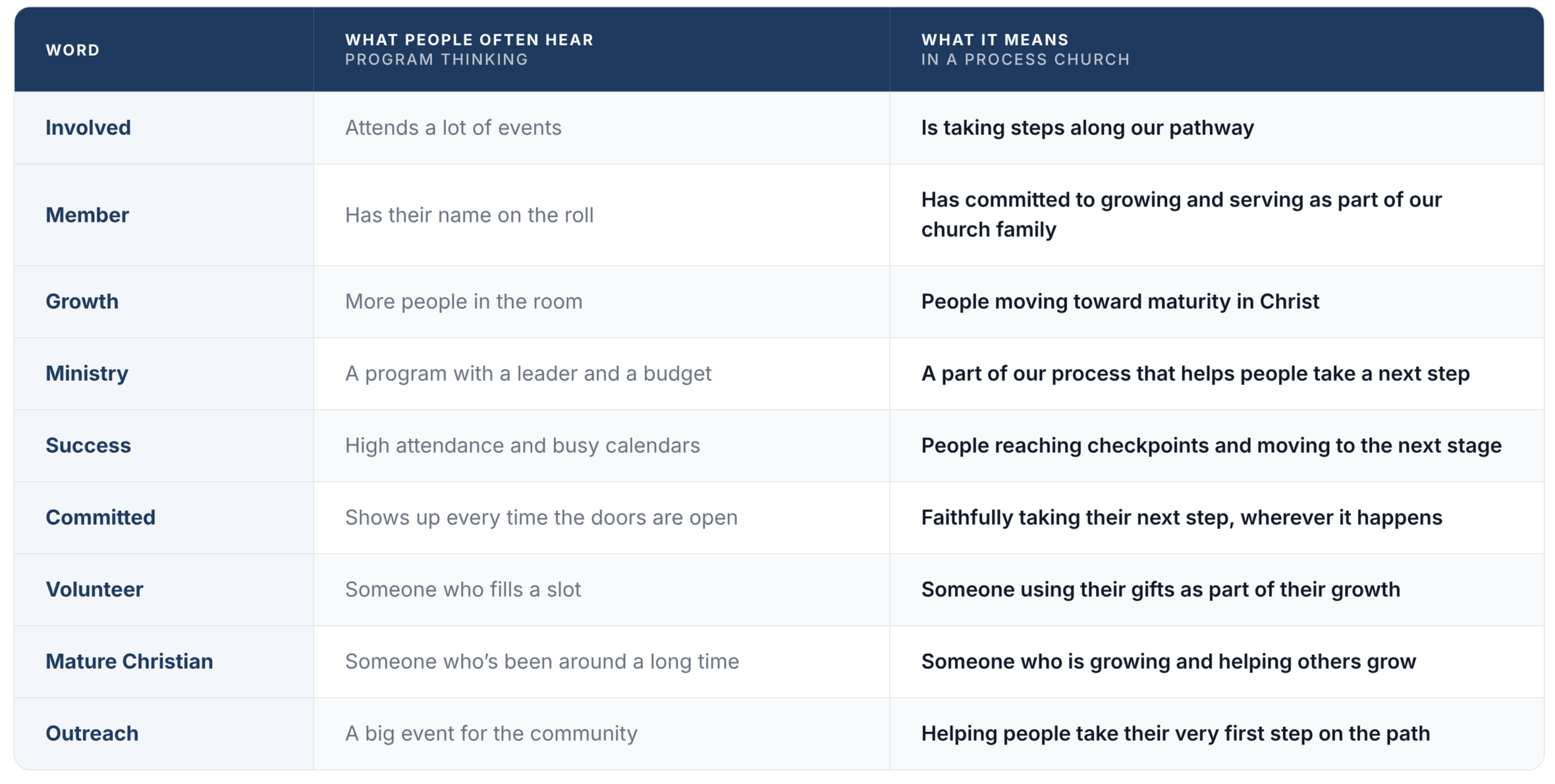
Notice that none of these words are bad. The problem is that they've picked up program meanings over time. Your job isn't to throw them out. It's to fill them with process meaning, and then use them that way consistently.
From Program Language to Process Language
Beyond individual words, the way we phrase things matters too. Small shifts in how you talk can point people toward the process instead of toward programs. Here are some examples:
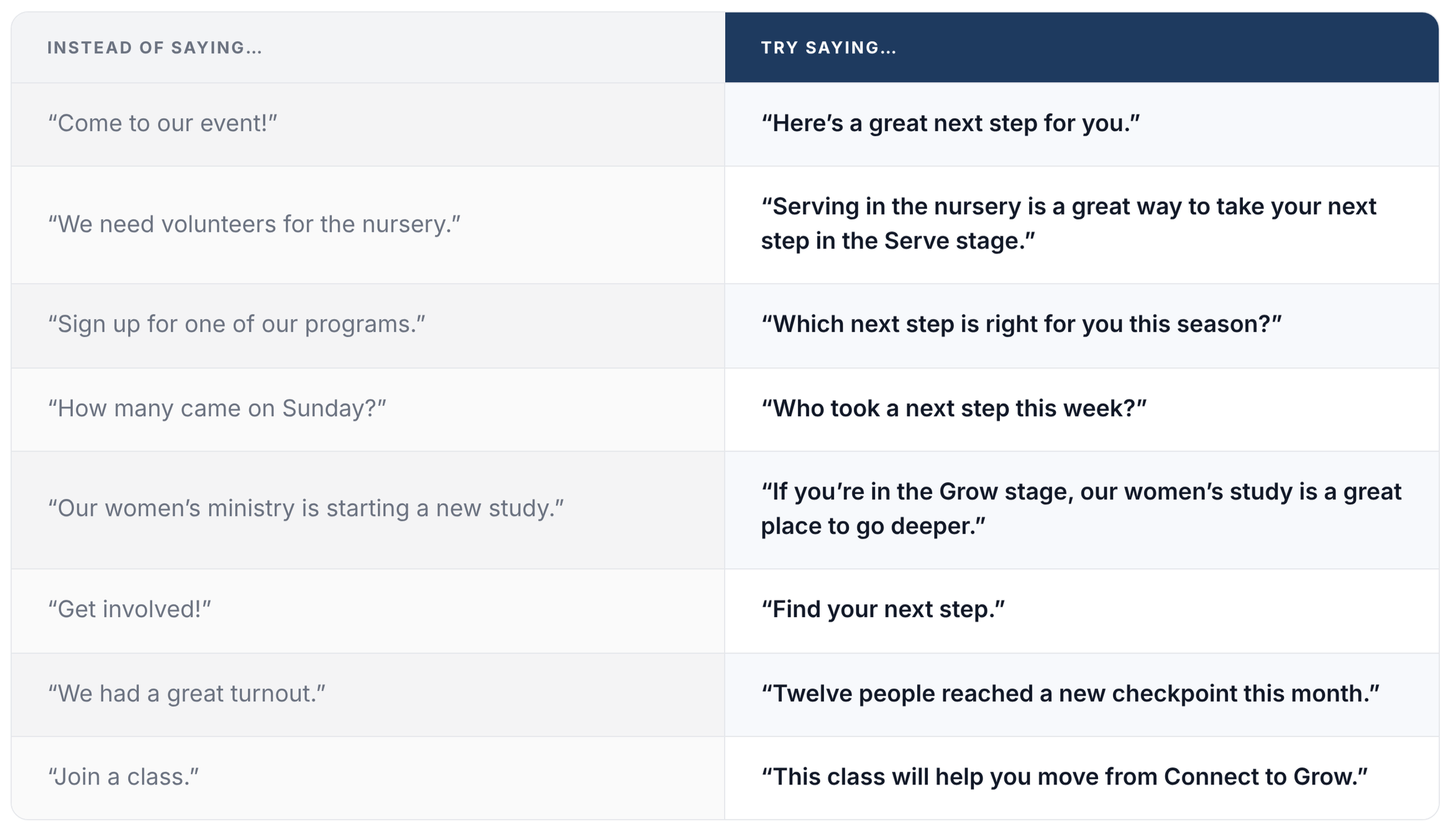
Notice the pattern. Process language always connects an activity to a person's growth. It answers the question, "How will this help me take my next step?" When people hear that question answered again and again, they start thinking that way too.
Building Your Church's Process Glossary
One of the most helpful tools you can create is a short glossary: a list of your church's key words and exactly what they mean. It becomes the shared dictionary for your leaders, staff, and volunteers. Here's how to build one:
Collect your words. Listen to a few sermons, read your bulletin and website, and sit in on a few meetings. Write down the words that come up most often.
Ask what people think they mean. Choose five or six key words and ask a handful of people from different parts of the church to define them. Note the differences.
Write clear definitions. For each word, write a one-sentence definition that connects it to your process. Use plain language anyone can understand.
Add your process words. Include your stage names, your checkpoint names, and phrases like "next step" and "guide."
Keep it short. Aim for 10 to 15 words. A glossary nobody reads doesn't help anyone.
Share it everywhere. Give it to every leader, review it at leadership meetings, and include it in new member and volunteer training.
Where to Change Your Language
New language only sticks when people hear it everywhere, over and over. Do a simple communication audit by checking each of these places and asking, "Does this sound like a program church or a process church?"
Sermons and teaching. Does your preaching regularly mention your stages and next steps? A short line at the end of a sermon, like "What's your next step this week?", goes a long way.
Announcements. Does every announcement connect to a stage or next step? Or is it just a list of events?
Bulletin and website. Can someone find your pathway and stages in under a minute? Does your website list programs, or does it show people how to grow?
Signs and printed materials. Do your welcome center, connection cards, and brochures use your stage names?
Leadership meetings. Do agendas focus on people taking steps, or on planning events?
Job and volunteer descriptions. Do roles describe how each person helps others move along the process?
Budget and reports. Are ministries listed and measured by the stage they serve and the movement they produce?
Everyday conversation. Are leaders asking people, "What's your next step?"
You won't change everything overnight, and that's fine. Start with the places people see most often, like Sunday announcements and your website. Then keep going. Over time, the new language will start to feel normal, and that's when your culture will really begin to shift.
Action Steps
Before you move on to Lesson 17, work through these on your own or with your team:
Try the five-person experiment. Ask five people what it means to be "involved" at your church. Write down every answer and notice the differences.
Read 1 Corinthians 1:10 and 1 Corinthians 14:8–9. Reflect on what happens when a church doesn't share the same language.
Collect your church's words. List the 15 to 20 words and phrases your church uses most often.
Draft your glossary. Using the template, write clear process definitions for 10 to 15 of your key words, including your stage and checkpoint names.
Rewrite three announcements. Take three recent announcements and rewrite them using process language.
Do a communication audit. Walk through each area on the audit list and note where your language still sounds like a program church.
Fix two things this month. Pick the two places people see most often, like your website or Sunday announcements, and update them first.
Share the glossary with your leaders. Walk through it together at your next leadership meeting and ask everyone to start using it.
When everyone speaks the same language, the whole church starts moving in the same direction. See you in Lesson 17!