
The Sunday Trap
In the last lesson, you made the process personal with next-step conversations and growth plans. Now we're going to tackle one of the biggest things that pulls churches back into program thinking: Sunday.
In a program-driven church, almost everything revolves around Sunday morning. The service, the classes, the announcements, the sign-up tables, the big events — it all happens in one building during one window of time. If you're there, you're plugged in. If you're not, you're out of the loop.
But let's be honest about what Sunday looks like today. Even your most committed people probably don't make it every week. A nurse works weekend shifts. A family has a kid in travel sports. A dad has custody every other weekend. A senior adult can't drive in bad weather. Someone's traveling for work or caring for a parent. None of them have stopped caring about their faith. They just can't always be in the building on Sunday morning.
Here's the problem: if your process only moves on Sundays, then every missed Sunday stalls it. People stop moving along your stages, miss their checkpoints, and slowly drift without anyone noticing. That's not a process. That's a program with a really good calendar.
A true process keeps working all week long. In this lesson, we'll look at how to build one that keeps people moving forward whether they're in the building this Sunday or not.
Programs Are Events. A Process Is a Flow.
Here's the key difference. A program is an event that happens at a set time and place. You're either there or you miss it. A process is a flow that keeps moving people toward their next step no matter where they are or what day it is.
Think of it like a river versus a pond. A pond only reaches the people standing on its shore. A river keeps moving, carrying things along with it wherever it flows. Sunday-only churches are ponds. Process churches are rivers.
The early church understood this. They gathered together, but their life together didn't stop when the gathering ended. They were "continuing daily with one accord in the temple, and breaking bread from house to house" (Acts 2:46, KJV). The big gathering and the everyday flow worked together.
Here's how the two ways of thinking compare:
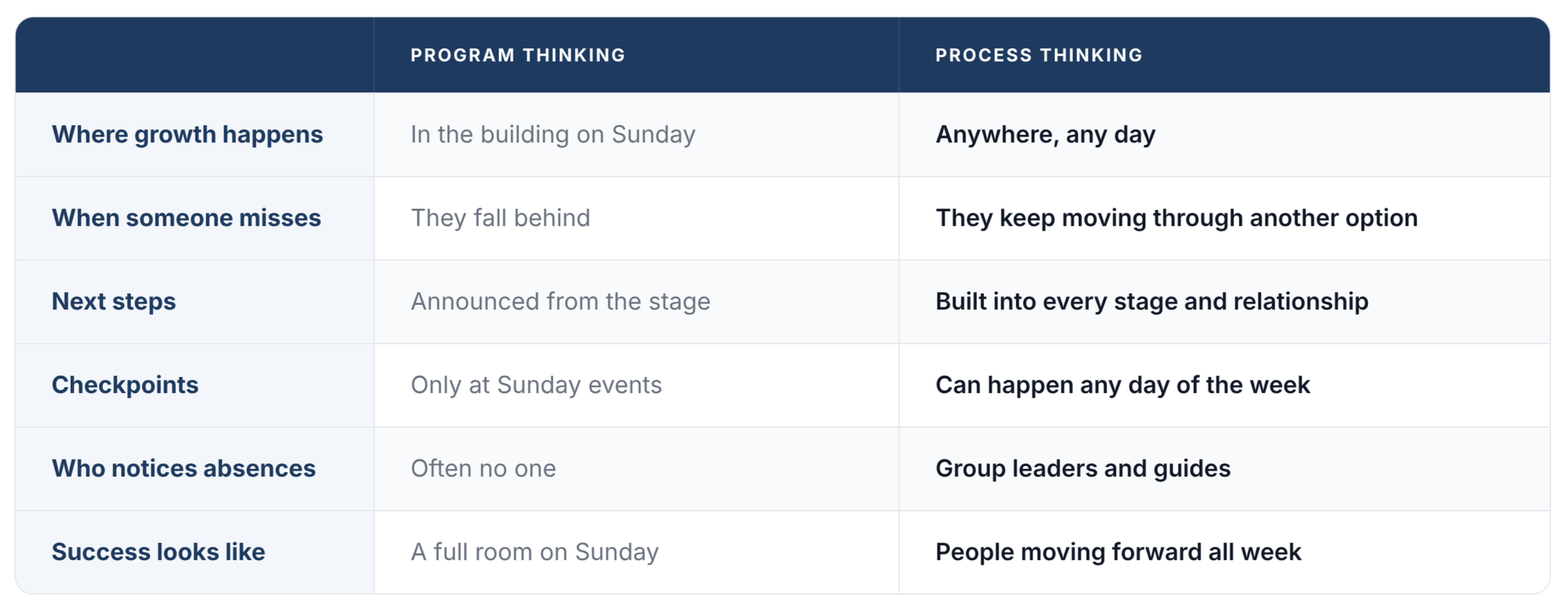
Sunday still matters a great deal. Gathering for worship is a vital part of your process. But it should be one part of the flow, not the whole thing.
Four Places Your Process Can Run Beyond Sunday
To keep your process flowing all week, think about four places where people can take steps along your stages besides the Sunday service.
1. Homes. Homes can be some of the strongest places in your process. Small groups that meet in living rooms, newcomers' gatherings around a dinner table, and next-step conversations over coffee all move people forward. Equipping families with simple weekly guides also helps parents keep the process going at home.
2. Groups and relationships. Weeknight groups, mentoring pairs, and serving teams that connect during the week keep people moving even when they miss Sunday. These relationships are also your early warning system. When someone misses a Sunday, their group notices first.
3. Digital spaces. Technology lets parts of your process run around the clock. Sermon recordings, online classes, group texts, short videos that explain each stage, and online sign-ups for next steps all help people keep moving from wherever they are. Digital tools shouldn't replace being together in person, but they keep the process from stopping when people can't be there.
4. Everyday life. The later stages of your process — serving others and helping people grow — often happen far from the church building. At work, in the neighborhood, and around the community, people can live out their stage every day. Help them see those places as part of the process too.
Building a Seven-Day Process
Now let's put it together. Go back to your stages from Lesson 7 and your checkpoints from Lesson 11. For each stage, ask: "If someone in this stage misses Sunday, how can they still move forward in our process?" Every stage should have at least one way to take a step that doesn't depend on Sunday morning.
Here's an example using the Connect, Grow, Serve, Go stages:
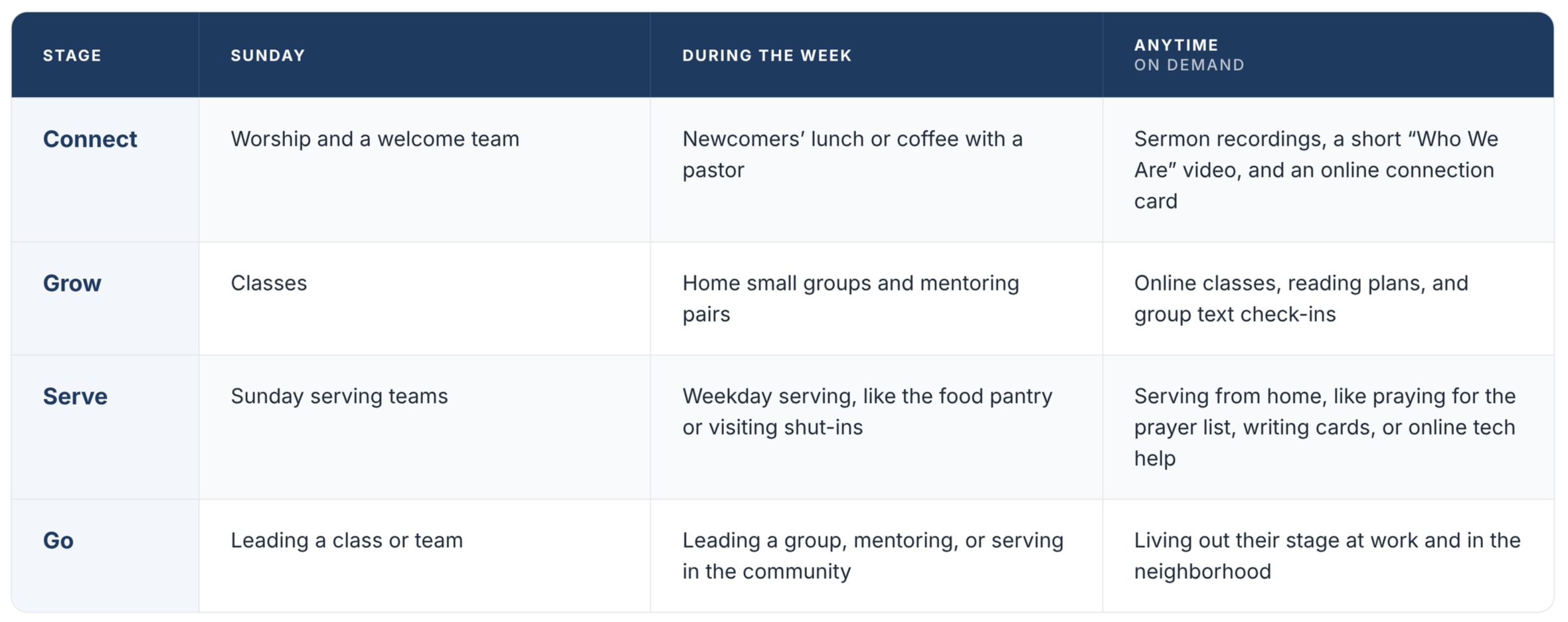
Your checkpoints can move off Sunday too. A next-step conversation can happen over Tuesday lunch. A newcomers' class can be offered on a weeknight or online. A small group can celebrate someone's step in a living room just as meaningfully as from the stage.
Keep it simple. You don't need to offer everything at every time. That would just turn back into a pile of programs. One or two good options outside of Sunday for each stage is a strong start.
Keeping the Process Moving When People Miss
Even with a great seven-day process, people will still miss Sundays. The goal is to make sure a missed Sunday never stops someone's progress. Here are some ways to build that into your process:
Make noticing part of the process. Give group leaders and guides the job of watching for absences. A good rule of thumb: if someone has missed two or three weeks in a row, someone reaches out.
Reach out with care, not guilt. A message like "We missed you! Hope your week is going well — anything I can pray about?" keeps the door open.
Point to their next step, not just the service. When you reach out, don't only share the sermon link. Remind them of their next step and how they can take it this week.
Let groups be the safety net. When everyone in your process is connected to a group or guide, no one falls through the cracks for long.
Plan for predictable seasons. Summer, holidays, and sports seasons pull people away. Plan short-term, flexible options for those seasons so the process keeps moving.
Measure movement, not attendance. Track how many people took a step or reached a checkpoint this month, not just how many were in the room on Sunday.
When your process keeps working all week, people stay connected. And when they come back on Sunday, they come back still moving forward, not starting over.
Action Steps
Before you move on to Lesson 14, work through these on your own or with your team:
Do a Sunday audit. Look at your stage map and checkpoints. Circle every step in your process that can only happen on a Sunday morning.
Read Acts 2:42–47. Write down every place and time you see the early church living out their faith beyond the big gathering.
Build your seven-day process chart. Create a table like the example above, with at least one off-Sunday option for each stage.
Move one checkpoint off Sunday. Pick one checkpoint and find a way people can reach it during the week or online.
Add one digital step. Choose one simple digital tool to start or improve, like an online connection card, sermon recordings, or online sign-ups for next steps.
Set up a "we missed you" system. Decide who notices when people are absent, when they'll reach out, and how they'll point people to their next step.
Change one measurement. Start tracking how many people took a step or reached a checkpoint each month, not just Sunday attendance.
You're building a process that keeps people moving every day, not just one morning a week. See you in Lesson 14!
