From a Church Path to One Person's Journey
You've done a lot of building. Your church now has named stages, mapped ministries, and checkpoints that mark the way. That's the church-wide pathway we talked about back in Lesson 4.
But here's the truth: nobody grows because a church has a great chart. People grow when someone knows them, believes in them, and helps them see what God might do next in their life. A pathway is only as strong as the personal relationships that help people walk it. So in this lesson, we're going to take everything you've built and make it personal.
Paul showed us what this looks like. Writing to the believers in Thessalonica, he said they had been "affectionately desirous of you" and were "willing to have imparted unto you, not the gospel of God only, but also our own souls, because ye were dear unto us" (1 Thessalonians 2:8, KJV). And then he added, "ye know how we exhorted and comforted and charged every one of you, as a father doth his children" (1 Thessalonians 2:11, KJV).
Did you catch that? Every one of you. Paul didn't just preach to a crowd and hope people figured it out. He knew them, cared for them, and encouraged each one personally. That's our goal too: to help every person see their own next step and feel supported as they take it.
The Next-Step Conversation
The single most powerful tool for making growth personal is a simple conversation. Not a lecture or a sales pitch — a real conversation where you listen more than you talk. It can happen over coffee, after a group meeting, or on a walk. It usually takes 30 to 45 minutes.
Here's a simple flow you can follow, with questions for each part:
1. Hear their story.
How did you come to faith, or where are you on your spiritual journey right now?
What brought you to our church?
What's going on in your life these days?
2. Discover where they are.
What's helping you grow closer to God right now?
Where do you feel stuck or dry?
Looking at our stages, where do you think you are today?
3. Explore who God made them to be.
What do you enjoy doing? What are you good at?
What breaks your heart or fires you up?
When have you felt most used by God?
4. Dream together about what's next.
What's one step you sense God might be inviting you to take?
What would make that step easier for you?
How can I help?
Notice that the person names their own next step whenever possible. When people choose their step, they own it. Your job is to listen well, point out what you see in them, and offer options that fit.
A Personal Growth Plan
At the end of a next-step conversation, help the person capture what you talked about in a simple personal growth plan. It doesn't need to be fancy. A single page is plenty. The point is to turn a good conversation into a clear, doable step.
Here's a template you can use or adapt:
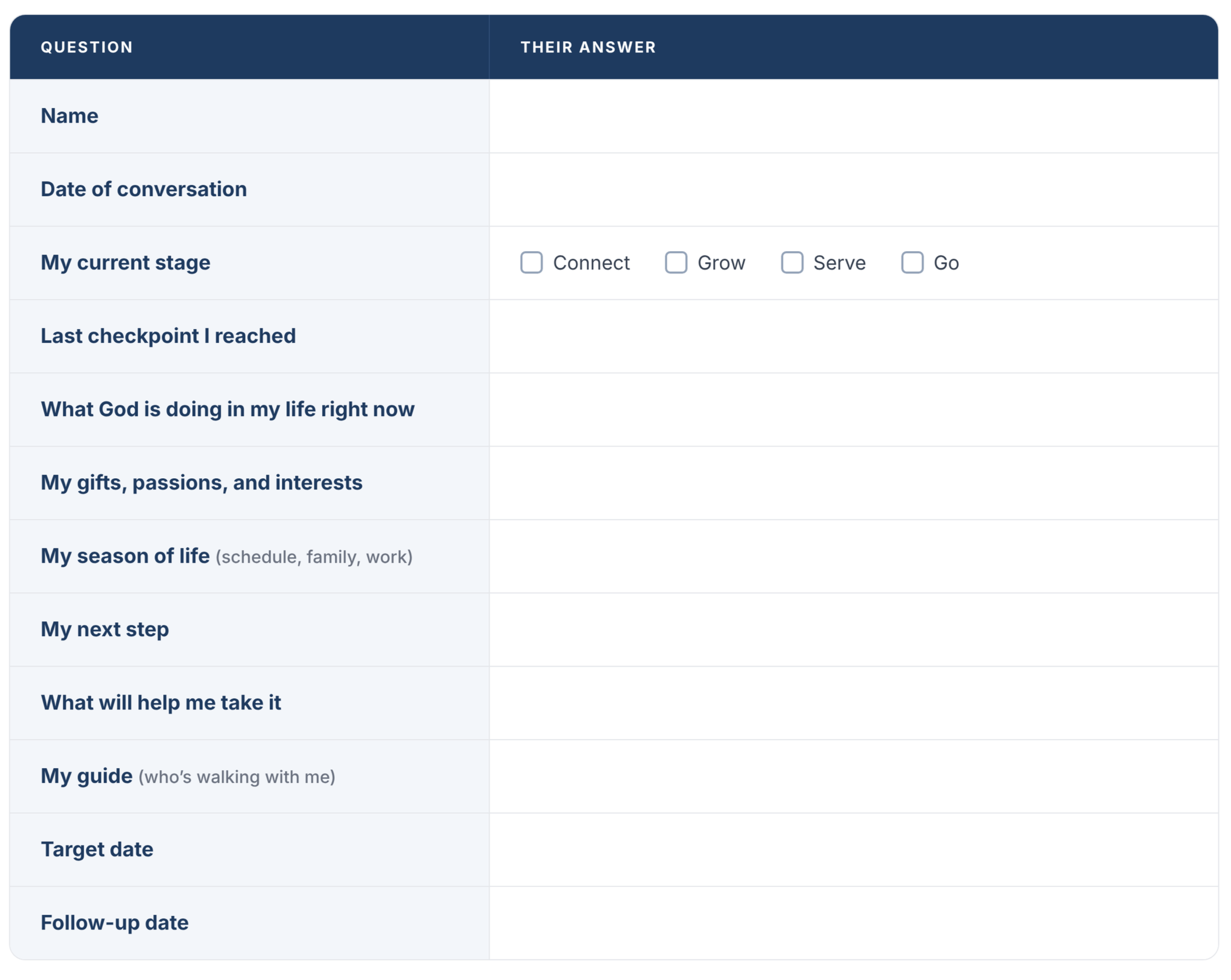
A few tips for using the plan:
Keep the next step small and specific. "Grow closer to God" is a hope. "Read the Gospel of Mark in the next 30 days" is a step.
Match the step to their season. A new mom and a recent retiree might both be in the Grow stage, but their best next step could look very different. This is where the individual options from Lesson 4 come in.
Give them a copy. Let them keep the plan. Many people tuck it into their Bible or put it on the fridge.
Put the follow-up on your calendar. The plan only works if someone checks back in.
Adding Value and Encouraging the Next Step
People take next steps when they see the value in them and feel supported along the way. Hebrews 10:24 tells us to "consider one another to provoke unto love and to good works" (KJV). That word consider means to think carefully about each person: what they need, what motivates them, and how to spur them on. Here are some practical ways to do that:
Connect the step to their "why." Don't just say, "You should join a small group." Say, "You mentioned feeling lonely since the move. A group could be a place to find real friends who'll walk with you." Show how the step meets a need they've already named.
Name what you see in them. People often can't see their own gifts. Say it out loud: "I've noticed how you make everyone feel welcome. I think you'd be amazing on our greeting team." A sincere word of affirmation can change someone's whole direction.
Make the step small and clear. A big leap feels scary. A small, specific step feels possible. Instead of "Become a leader," try "Would you co-lead the next group with me for six weeks?"
Go with them. Offer to sit with them at their first group meeting or introduce them to the team leader. Removing the awkwardness of walking in alone removes one of the biggest barriers.
Celebrate every step. A text that says, "So proud of you for coming tonight!" goes a long way. Celebrate effort, not just results.
Follow up faithfully. Check in a week later, then a month later. Ask how it's going, what they're learning, and what might be next.
Pray for them by name. And tell them you're praying. Few things make people feel more valued.
When people feel known, valued, and supported, next steps stop feeling like church obligations. They start feeling like an adventure with God and with friends.
When Someone Gets Stuck
Not everyone will take their next step right away. Some people will stall, hesitate, or step back for a while. That's normal, and it's often when personal care matters most.
Think about Peter. After he denied Jesus three times, he went back to fishing. He was stuck. But Jesus came to find him on the shore, cooked him breakfast, and asked him three times, "Lovest thou me?" Each time, Jesus gave him a next step: "Feed my sheep" (John 21:15–17, KJV). Jesus didn't shame Peter. He restored him personally and pointed him forward.
When someone gets stuck, try this:
Ask before assuming. "I noticed you haven't been at group lately. How are you doing?" There may be a hard season you don't know about.
Listen for the real barrier. It might be fear, schedule, a hurt, doubt, or simply not knowing how to start.
Adjust the step. If the step was too big, make it smaller. If the timing was wrong, find another option.
Keep the door open. Let them know there's no pressure and no guilt. You'll be there when they're ready.
Sometimes the most important next step is simply staying connected.
Action Steps
Before you move on to Lesson 13, work through these on your own or with your team:
Read 1 Thessalonians 2:7–12. Write down every word Paul uses to describe how he cared for people personally.
Create your growth plan template. Adapt the personal growth plan to fit your stages and checkpoints, and make it easy to print or share.
Have one next-step conversation yourself. Before asking others to do it, sit down with one person this week and walk through the four parts of the conversation.
Decide who will have these conversations. Make a list of leaders — group leaders, team leaders, staff, mentors — who could guide others. Aim for one guide for every 8 to 12 people.
Train your guides. Plan a short training time to walk your leaders through the conversation questions and the growth plan.
Write three words of encouragement. Think of three people in your church who are ready for a next step. Write each one a note naming what you see God doing in them.
Reach out to someone who's stuck. Think of one person who has drifted, and check in on them this week with no pressure.
You're turning a church-wide pathway into a personal journey for every person who walks through your doors. See you in Lesson 13!