Pruning for More Fruit
Up to this point, you've been gathering facts and drawing maps. You've looked honestly at your church, named your stages of growth, and placed every ministry on those stages. You can now see where your church is strong, where it's thin, and where there are gaps.
Now comes the part that takes courage: making decisions. In this lesson, you'll decide which ministries stay just as they are, which ones get transformed, and which ones it's time to lovingly retire.
Jesus gave us a powerful picture for this. He said, "Every branch in me that beareth not fruit he taketh away: and every branch that beareth fruit, he purgeth it, that it may bring forth more fruit" (John 15:2, KJV). Notice that even the fruitful branches get pruned. Pruning isn't punishment. It's how a healthy plant puts its energy where it will do the most good.
That's what we're doing here. We're not cutting things just to cut them. We're making room so the ministries that matter most can flourish, and so every part of your church works together to help people grow. By the end of this lesson, you'll have a plan for each ministry and a picture of how they can all pull in the same direction.
The Three Choices
Every ministry on your map will land in one of three places:
Keep. These ministries are already doing what they should. They clearly serve a stage of growth, they bear real fruit, and they point people toward a next step. You might make small tweaks, but the core stays the same.
Transform. These ministries have good bones but need to be reshaped. Maybe they serve the right people but don't lead anywhere. Maybe they've drifted from their original purpose. Or maybe they could fill a gap on your map with a few changes. Most of your ministries will probably land here, and that's good news. Transformation lets you keep what people love while giving it a clearer purpose.
Retire. These ministries have served their season. They no longer fit any stage of growth, they take more than they give, or something else now does the job better. Retiring a ministry isn't a failure. As Ecclesiastes 3:1 reminds us, "To every thing there is a season, and a time to every purpose under the heaven" (KJV).
There's one more category worth naming: Start. As you look at your gaps, you may find a stage or bridge that has nothing supporting it. Before you start something new, though, always ask whether you can transform something you already have. New ministries take a lot of energy, so start one only when you truly need it.
How to Decide
These decisions can get emotional fast, so it helps to have a clear, fair way to make them. Run every ministry through the same five filter questions:
Purpose: Does it clearly serve one of our stages of growth?
Fruit: Is it actually helping people grow, not just keeping them busy?
Next step: Does it point people toward the next stage?
Cost: Is the time, money, and volunteer energy it takes worth the fruit it bears?
Uniqueness: Is it doing something no other ministry is already doing?
Score each question from 1 (not at all) to 3 (very much). Use your ministry inventory from Lesson 6 and your map from Lesson 8 to keep the scores grounded in facts.
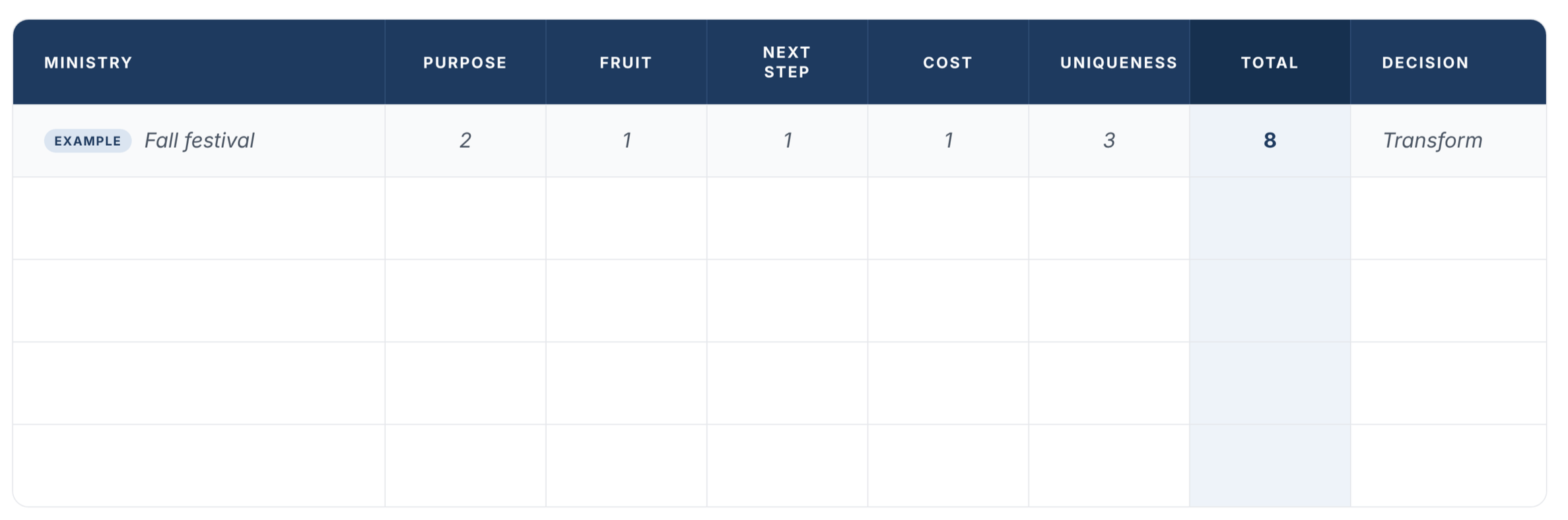
Here's a simple guide for reading the totals:
13–15: Keep. It's healthy. Celebrate it and look for small improvements.
9–12: Transform. There's something worth keeping. Figure out what needs to change.
5–8: Consider retiring. Take a hard look, especially if purpose and fruit are both low.
The scores are a starting point, not the final word. A ministry with a low score might still be worth transforming if it reaches people nothing else does. Talk it through, pray, and use wisdom. A few more questions can help when you're stuck:
If we weren't already doing this, would we start it today?
If this ministry ended tomorrow, who would really miss it, and why?
What could our people and money do instead if we freed them up?
Ideas for Transforming Ministries
Transforming a ministry usually doesn't mean starting over. Often it's one or two smart changes that give it a clear purpose and a clear next step. Here are some before-and-after ideas to spark your thinking:
When you transform a ministry, ask three questions:
What stage does it serve? Sharpen its focus on that one stage.
What's the next step? Build a clear invitation into the very next stage.
Who's the bridge? Name a person or moment that personally helps people take that step.
Retiring a Ministry Well
Let's be honest: retiring a ministry can be the hardest part of this whole course. Behind every program are people who poured their hearts into it. How you end something matters just as much as the decision to end it. Here are some ways to do it with grace:
Talk to the leaders first. Never let a ministry leader hear the news in a meeting or from the pulpit. Sit down with them personally, explain the why, and listen.
Celebrate what God did. Hold a thank-you gathering, share stories, and honor the people who served. Let it end with gratitude, not a whimper.
Give it time. Set a clear end date a few months out instead of stopping it overnight. This gives people time to adjust.
Show people where to go next. Help everyone involved find a new place to grow or serve, ideally in a ministry that fits your pathway.
Redirect the resources. Tell your church where the freed-up time, money, and volunteers are going. When people see the new fruit, the loss makes sense.
Start small. If your church has never retired anything, begin with one low-stakes ministry. An early, gentle win builds trust for bigger changes later.
Creating Synergy
Here's where the magic happens. Once you've decided what to keep, transform, and retire, the goal isn't just a shorter list of ministries. It's a set of ministries that work together, so that the whole is greater than the sum of its parts. Paul describes this kind of church beautifully: "the whole body fitly joined together and compacted by that which every joint supplieth… maketh increase of the body unto the edifying of itself in love" (Ephesians 4:16, KJV).
Here are some practical ways to build that synergy:
Design hand-offs, not dead ends. Every ministry should know which ministry comes next on the path. Plan the hand-off together: who invites, when, and how.
Think like a relay team. A greeter connects a guest to a newcomers' class. The class leader walks them into a small group. The group leader helps them find a serving team. Each person carries the baton for one leg of the race.
Align your teaching. When a sermon series, small group study, and kids' lesson all focus on the same theme, the whole church grows together.
Plan the calendar as one. Instead of each ministry planning on its own, map out the year together so events build on each other instead of competing.
Share leaders and stories. Have ministry leaders meet regularly to share wins and pass along people who are ready for their next step.
Use one set of words. Make sure every ministry uses your stage names. Shared language creates a shared journey.
When your ministries start working this way, people stop falling through the cracks. Growth doesn't depend on someone figuring it out alone. The whole church helps them take their next step.
Action Steps
These decisions take time and prayer, so give yourself a couple of weeks. Before moving on to Lesson 10:
Read John 15:1–8. Ask God to show you where He wants to prune so your church can bear more fruit.
Score every ministry. Run each ministry on your map through the five filter questions and fill in the scoring worksheet.
Make a first-draft decision. Label each ministry Keep, Transform, Retire, or Start. Write one sentence explaining why.
Plan your transformations. For each ministry you're transforming, write down the stage it serves, its new next step, and who will be the bridge.
Draft a retirement plan. For any ministry you're retiring, write out who you'll talk to first, how you'll celebrate it, and the end date.
Draw your hand-offs. On your stage map, draw arrows from each ministry to the one that comes next. Look for any dead ends.
Bring it to your team. Share your draft decisions with your leaders, listen to their input, and agree on a final list together.
Pray for the people affected. Pray by name for the leaders and members whose ministries are changing.
You're not just trimming a list. You're building a church where every ministry helps people grow. See you in Lesson 10!