Looking for What's Missing
In the last lesson, you made some big decisions. You chose which ministries to keep, which to transform, and which to retire. You started drawing hand-offs so your ministries work together. That took courage, and you should feel good about it.
Now we're going to look at your map from a different angle. Instead of asking, "What do we have?" we're going to ask, "What's missing?" Every church has gaps — places along the path where people get stuck, fall through the cracks, or simply have nowhere to go next. Finding those gaps is one of the most important things you'll do in this course.
When Nehemiah's people were rebuilding the wall and enemies threatened to attack, he didn't spread his people evenly. Scripture says he "set… in the lower places behind the wall" (Nehemiah 4:13, KJV). He looked for the weak spots and put his people there. That's what we're doing in this lesson.
And remember why this matters. Behind every gap is a real person. Jesus told about a shepherd who had a hundred sheep and lost one. He didn't shrug it off. He left the ninety-nine and went after the one "until he find it" (Luke 15:4, KJV). Every gap you find and fill means fewer people getting lost along the way.
Five Kinds of Gaps
Gaps come in different shapes. As you study your map, look for each of these:
Stage gaps. A whole stage has little or nothing supporting it. This is often the last stage — helping people disciple others and share their faith.
Bridge gaps. Each stage has good ministries, but nothing helps people move from one stage to the next. People are stuck in the middle of the path.
People gaps. A stage works well for some people but not others. Maybe your "Grow" stage is strong for retirees but has nothing for young families, singles, or men.
Access gaps. The right ministry exists, but people can't get to it. It meets at a time that doesn't work, is only offered once a year, or nobody knows about it. This connects back to the individual options we talked about in Lesson 4.
Leadership gaps. A ministry is needed, but there's no one equipped to lead it. Or one person is carrying a load that should be shared.
Most churches will find a few of each. Don't be discouraged. Naming them is the first step toward filling them.
Four Tools for Finding Gaps
Tool 1: Revisit Your Map
Pull out your ministry map from Lesson 8 and the decisions you made in Lesson 9. After keeping, transforming, and retiring, which stages are now empty or thin? Where are the arrows between ministries missing? Circle every spot where a person would hit a dead end.
Tool 2: Walk the Path
Pick a few imaginary (or real) people and walk them through your church, step by step. For example: a single dad who visits on Easter, a college student who just became a Christian, or a long-time member who's ready to lead. For each one, ask: What's the first thing that happens? What's their next step? Who invites them? Where would they get stuck? You'll be amazed how quickly the gaps show up when you put a face on them.
Tool 3: The People Grid
This grid helps you spot people gaps and access gaps. Replace the stage names with your own, then fill in each box with the ministries that serve that group at that stage. Empty boxes are gaps.
Tool 4: Listen
Your people know where the gaps are, even if they've never said so. Ask a handful of people from different stages and life seasons a few simple questions: "When did you feel stuck in your faith here?" "What did you wish was available?" "What made it hard to take a next step?" Also look at your people numbers from Lesson 6. Wherever the numbers drop off sharply, there's probably a gap.
Deciding Which Gaps to Tackle First
Once you start looking, you may find more gaps than you can fill at once. That's normal. You don't have to fix everything this year. The key is to start with the gaps that will make the biggest difference.
List your gaps in the table below. For each one, rate the impact (how many people it affects and how much it matters for their growth) and the effort (how much time, money, and leadership it would take to fill). Use High, Medium, or Low.
Then sort them like this:
High impact, low effort: Do first. These are your quick wins. They build momentum and show your church that change is working.
High impact, high effort: Plan next. These are worth it, but they need time, leaders, and resources. Start planning now.
Low impact, low effort: Fit in when you can. Nice to have, but don't let them distract you.
Low impact, high effort: Set aside for now. Revisit them later.
Most churches do well to focus on two or three gaps at a time. Bridge gaps are often the best place to start, because one simple connection can help people move through your whole pathway.
Ideas for Filling Common Gaps
You don't always need a brand-new program to fill a gap. Often, a simple tweak, a single person, or a short-term step does the job. Here are some ideas to get you started:
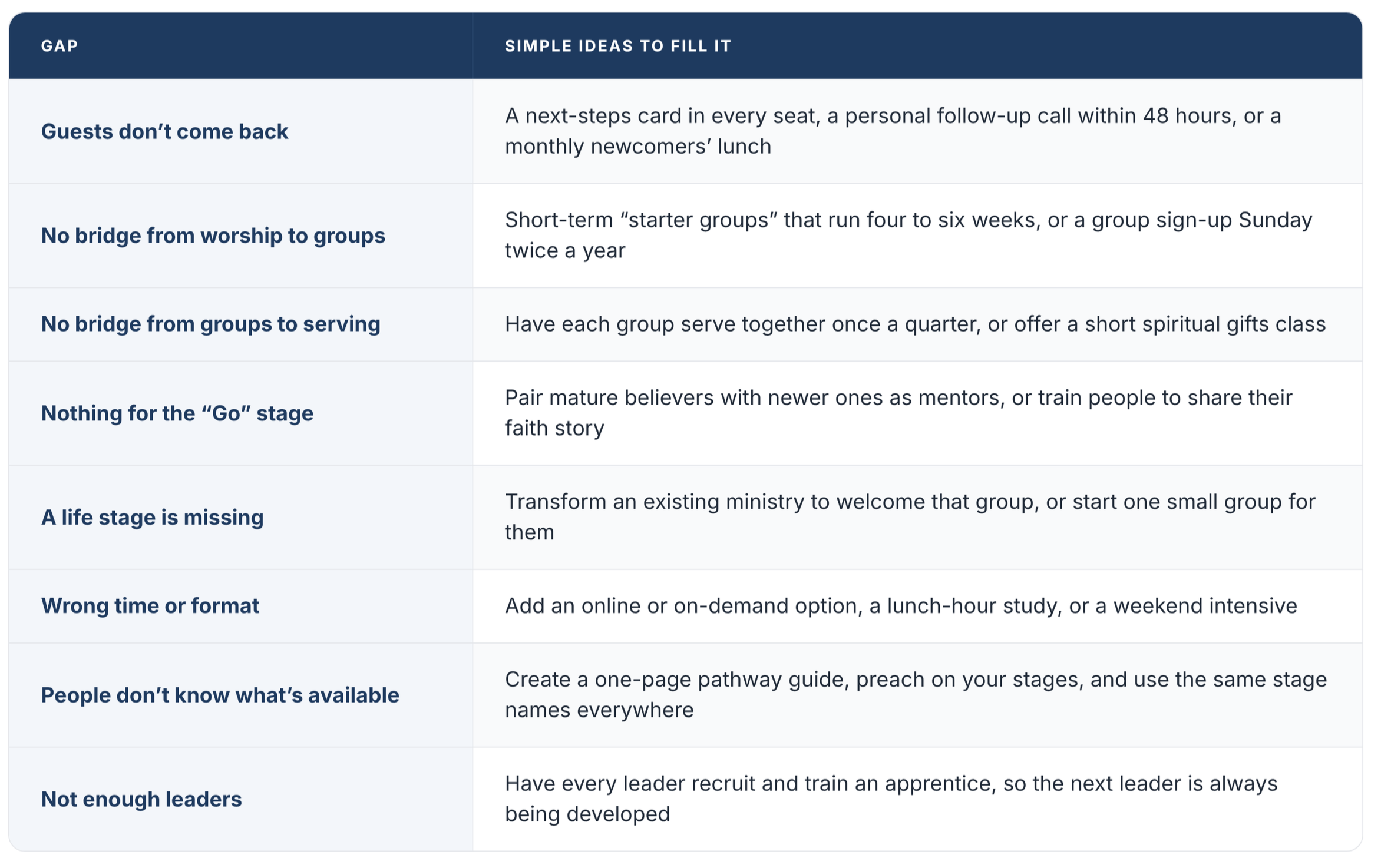
Before you start something new, always check your Lesson 9 list first. A ministry you marked "Transform" might be exactly what you need to fill a gap.
Action Steps
Before you move on to Lesson 11, work through these on your own or with your team:
Read Luke 15:1–7. Reflect on the shepherd who went after the one. Who in your church might be falling through the gaps right now?
Circle the dead ends. Go back to your ministry map and mark every place where a person has no clear next step.
Walk the path three times. Choose three different people — real or imagined — and trace their journey through your church. Write down where each one gets stuck.
Fill in the people grid. Complete the grid and highlight every empty box.
Listen to five people. Ask five people from different life stages where they've felt stuck and what they wish your church offered.
List and rate your gaps. Put every gap you found into the priority table and rate its impact and effort.
Choose your top three. Pick the two or three gaps you'll tackle first, and write one idea for filling each.
Pray for the gaps. Ask God to raise up the people and resources needed to fill them.
Finding the gaps can feel a bit overwhelming, but it's actually good news. Now you know exactly where to focus. See you in Lesson 11!