
Preperation
Every Good Building Starts With a Foundation
By now you've chosen how you'll go through this course, set your schedule, and maybe gathered a team. That's a big deal. Now it's time to roll up our sleeves and get to the heart of what we're doing together.
Anyone who has ever built a house knows you don't start with the paint colors or the kitchen cabinets. You start with the foundation. If the foundation is off, everything you build on top of it will eventually crack. Churches work the same way.
In this lesson, we're going to lay that foundation by getting really clear on what "process over programs" actually means. We'll paint a picture of each kind of church, compare them side by side, and then look at what you're going to gain by making this shift. My hope is that by the end, you'll be able to explain the difference to anyone in your church in just a couple of sentences.
What a Program-Driven Church Looks Like
Let me say this clearly up front: program churches are full of good people doing good things. Nobody sets out to build a program church. It usually happens slowly and with the best of intentions.
It often goes something like this. Someone sees a need — young moms need encouragement, or the men aren't connecting — so a ministry gets started. It goes well, so it keeps going. A few years later, someone else sees a different need and starts another ministry. Then a new pastor arrives with a favorite program from their last church. Before long, the church has a long list of activities, and each one has its own leader, its own budget, and its own spot on the calendar.
Here are some signs you might be in a program-driven church:
Success is measured by attendance. If the room is full, it was a good event.
Ministries compete. They compete for volunteers, money, rooms, and space in the bulletin.
Busy equals faithful. Committed members are the ones at church three or four nights a week.
Nobody can explain the path. If a new person asks, "How do I grow here?" you'd likely get a different answer from every leader.
Programs rarely end. It's easy to start something and very hard to stop it, even when it's no longer bearing fruit.
Leaders are tired. The machine needs constant feeding, and the same faithful few keep it running.
What a Process-Driven Church Looks Like
A process church starts with the end in mind. Before it asks, "What should we do?" it asks, "What kind of disciples are we trying to make?" Once that answer is clear, the church builds a simple, step-by-step path that helps people move toward it.
Picture a simple path with a few clear steps. For many churches, those steps look something like this:
Connect — A person comes to worship and starts to feel at home.
Grow — They join a small group or class where they build relationships and go deeper with God.
Serve — They discover their gifts and start using them to serve others.
Multiply — They start investing in someone else and sharing their faith.
Your steps may have different names, and that's great. What matters is that every ministry knows where it fits on the path and what next step it's helping people take.
Here are some signs of a process-driven church:
Success is measured by movement. The question isn't just "How many came?" but "How many took a next step?"
Ministries work together. They pass people along the path like a relay team, not like rivals.
Fewer things, done better. The calendar is simpler, so people have time to actually live out their faith.
Anyone can explain the path. From the senior pastor to the greeter at the door, people know how someone grows here.
Programs serve the process. If a ministry doesn't help people take a next step, it gets reworked or retired.
Leaders are energized. They can see the fruit, and they know their work matters.
Side by Side
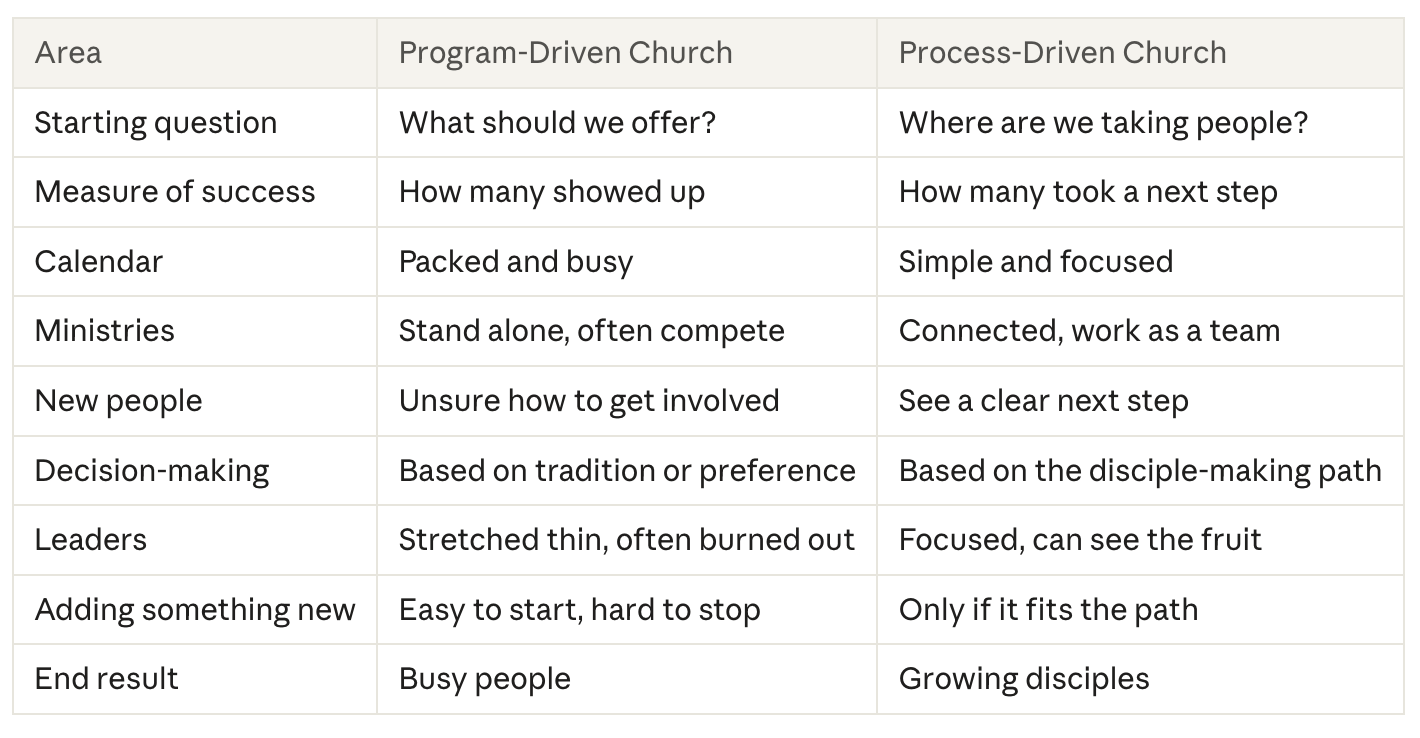
Sometimes it helps to see the two approaches next to each other. As you read through this table, be honest about where your church lands on each row. Most churches are a mix of both.
What You're Building
So why go through all this work? Because by the end of this course, you won't just have a few new ideas. You'll have built something that can serve your church for years to come. Here's what you can look forward to:
A clear definition of a disciple. You'll be able to describe, in simple words, what a growing follower of Jesus looks like in your church.
A simple discipleship path. You'll have a few clear steps that show people how to grow, and everyone in the church can understand them.
Aligned ministries. Every ministry will know its role on the path and what next step it's helping people take.
A simpler calendar. You'll free up time, money, and volunteers by focusing on what matters most.
Better ways to measure. You'll know how to track real growth, not just attendance.
A united leadership team. Your leaders will share the same vision and speak the same language.
A plan for the transition. You'll have practical steps for leading the change with wisdom and care, so you bring your people along instead of leaving them behind.
Best of all, you'll be building a church where people don't just stay busy — they actually grow. And that's what this is all about.
Action Steps
Before you move on to Lesson 4, work through these on your own or with your team:
Score your church. Go through the side-by-side table row by row. For each one, rate your church from 1 (fully program-driven) to 5 (fully process-driven). Total it up and talk about what you notice.
Try the "new person" test. Imagine someone asks, "How do I grow here?" Write down the answer you'd give. Then ask two or three other leaders the same question and compare.
Revisit your ministry list. Take the list from Lesson 1 and put a star next to any ministry where you can clearly explain the next step it helps people take.
Start describing a disciple. In a few sentences, write what you think a growing disciple looks like. Don't worry about getting it perfect — we'll build on this later.
Practice your explanation. Try explaining "process over programs" in two sentences or less. Share it with someone this week and see if it makes sense to them.
Pray for clarity. Ask God to show you where your church is today and where He's leading you.
You've got a solid foundation now. See you in Lesson 4!