
REAL WORLD LESSON · DEVELOPING A COMMUNICATION PLAN
Before & After: The Sunday Morning Conversation
Communication isn’t only what we post, print or send. Some of the most important communication a church does happens in the lobby, face to face, in the first few minutes someone is with us. This lesson follows one family through the same Sunday morning twice: once at a friendly church, and once at an engaged one.
THE SITUATION
Carlos and Ana Rivera just moved to town from Ohio for Carlos’s new job. This is their first Sunday visiting Grace Community Church. They bring their six-year-old daughter, Sofia.
Most churches would describe themselves as friendly. Watch what “friendly” looks like from the Riveras’ side.
Before: A friendly church
Everyone in this scene is kind. No one is rude. The numbers in brackets mark the problems explained below.
AT THE FRONT DOOR, 10:20 AM
A greeter smiles and holds out a bulletin.
Greeter: Good morning! Welcome to Grace! [1]
Carlos: Thanks.
The Riveras walk in, unsure where to go. They find seats near the back. Sofia stays with them; nobody mentions a kids’ program. [5]
IN THE LOBBY AFTER THE SERVICE
Carlos and Ana stand near the coffee table with Sofia. Around them, members gather in small circles, catching up with each other. [4]
Linda: Hi there! Are you new?
Ana: Yes, it’s our first time. We just moved here.
Linda: Oh, how nice! We’re so glad you came. You’ll love it here. Be sure to fill out the connection card in your bulletin! [2]
Linda smiles and turns back to her friends. [3]
AT THE EXIT
Pastor: Thanks so much for coming! Hope to see you next week! [6]
A warm handshake. The connection card is still folded in the bulletin.
IN THE CAR
Ana: Everyone was really nice.
Carlos: Yeah… nobody really talked to us, though.
Ana: Did you ever find out if they have anything for Sofia?
Carlos: No. I didn’t want to bother anyone.
What goes wrong
[1] A greeting, not a conversation “Good morning! Welcome to Grace!”
Nobody shares a name or learns one. The Riveras are welcomed, but they stay strangers.
[2] Interest that stops at one question “Oh, how nice! You’ll love it here.”
Linda hears “we just moved here” and doesn’t ask a single follow-up. She talks about the church instead of learning about them.
[3] Handing people off to paper “Fill out the connection card”
Connection gets turned into a form. The Riveras are asked to do the work of getting connected, on their own.
[4] Friendly to each other, not to guests Members in their own circles
The church is warm, but the warmth is pointed inward. Guests stand on the edge of conversations they aren’t part of.
[5] Their real needs are missed Sofia never comes up
A young family’s first question is usually “What about our kids?” Nobody noticed, and nobody asked.
[6] No next step and no follow-up “Hope to see you next week!”
They leave without a name, a contact or a reason to come back. Everyone was friendly, and the Riveras still walked out alone.
After: An engaged church
Same family, same church, same Sunday. This time, Mike, a member who serves on the welcome team, sees them come in. The numbers match the problems above, showing how each one was fixed.
AT THE FRONT DOOR, 10:20 AM
Mike: Good morning! I don’t think we’ve met. I’m Mike. [1]
Carlos: Carlos. This is my wife, Ana, and our daughter, Sofia.
Mike: Great to meet you, Carlos, Ana… and Sofia! Is this your first time at Grace?
Ana: It is. We just moved here from Ohio.
Mike: Welcome to town! What brought you here? [2]
Carlos: I started a new job at St. Luke’s. I’m a nurse.
Mike: That’s great. How’s the move been?
Ana: Honestly, a little overwhelming. We don’t really know anyone yet.
Mike: That makes sense. Sofia, how old are you?
Sofia: Six!
Mike: We have a kids’ class during the service that a lot of six-year-olds love. I’d be happy to walk you over and introduce you to Ms. Karen, who leads it. Or Sofia can stay with you today. Whatever you’re comfortable with. [5]
Ana: Maybe she’ll stay with us this first time.
Mike: Totally fine. There are activity bags right here if she’d like one. Can I show you where to sit?
IN THE LOBBY AFTER THE SERVICE
Mike: Carlos, Ana, how was it?
Carlos: Really good, actually.
Mike: I’d love for you to meet Dave and Michelle. They moved here from Columbus a couple of years ago, and their daughter is about Sofia’s age. [4]
Mike walks them over and introduces them by name. Dave and Michelle ask about the move, swap stories about Ohio, and Michelle mentions the park where their family goes on Saturdays. [4]
Mike: Would it be okay if I sent you a text this week? I can send you info on the kids’ class and our Newcomer Lunch next month. It’s an easy way to meet a few more people. [3]
Ana: Sure, that would be great.
Carlos and Mike swap numbers.
TUESDAY AFTERNOON, A TEXT FROM MIKE
“Hi Carlos, it’s Mike from Grace. It was great meeting you, Ana and Sofia on Sunday! Here’s the info on the Newcomer Lunch: Sunday, December 6, right after the service. Lunch is free and the kids eat with us. Hope the new job is going well. Let me know if I can help with anything as you get settled.”
[6]
IN THE CAR, SUNDAY
Ana: Michelle invited us to the park on Saturday.
Carlos: And Sofia already wants to go to Ms. Karen’s class next week.
Why it’s better
Each fix turns friendliness into engagement, and each connects to a lesson in the course:
[1] Names first (Lesson 13: Engagement vs Friendliness)
Mike introduces himself, learns every name, including Sofia’s, and uses them. The Riveras stop being “the new people” and become Carlos, Ana and Sofia.
[2] Curious about them, not just about us (Lesson 2: A Matter of Perspective)
Mike asks what brought them, how the move has been, and listens to the answers. Ana feels safe enough to say they don’t know anyone yet.
[3] A person, not a card (Lesson 12: Becoming Intentional)
Instead of “fill out the card,” Mike asks permission to stay in touch and does the work of connecting them himself.
[4] Connected to people like them (Lesson 9: Know Your Audiences)
An introduction to another family who moved from Ohio and has a daughter Sofia’s age turns one contact into a relationship.
[5] Their real need is noticed, and their choice respected (Lesson 14: Expressing Value)
Mike notices Sofia, offers the kids’ class, and is completely fine when they keep her with them. Helpful without pressure.
[6] A next step and a personal follow-up (Lesson 11: Process not Program · Lesson 19: Email, Texting, and Outreach)
A clear invitation to the Newcomer Lunch, and a text two days later from the same person they met, so the conversation keeps going after Sunday.
Friendly vs. engaged at a glance
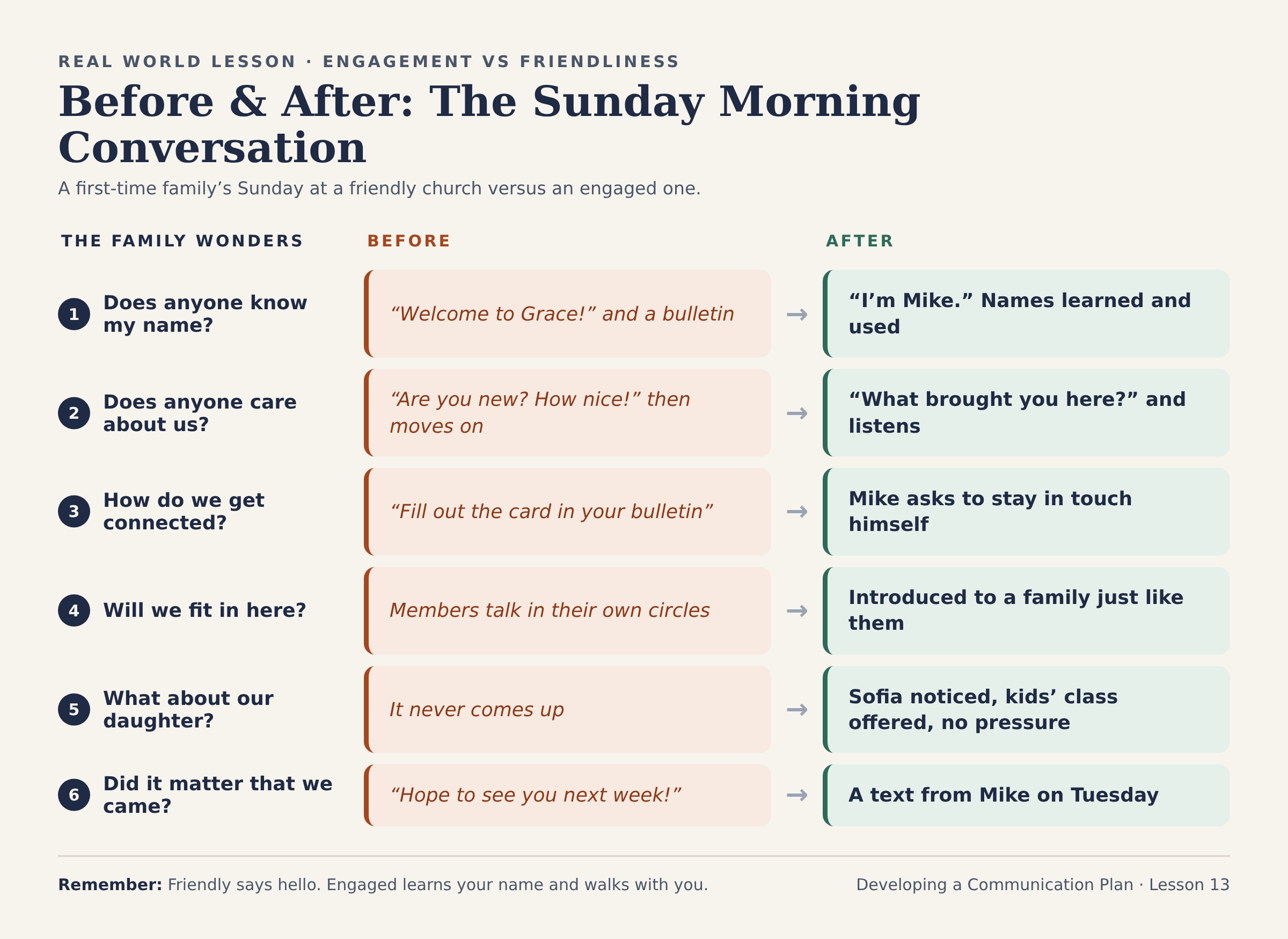
Take it with you: conversation starters that engage
Good questions are open, easy to answer, and about them. A few to practice:
• “I don’t think we’ve met. I’m ___.” Lead with your own name. It invites theirs.
• “What brought you to Grace today?” Opens the door to their story without prying.
• “How long have you lived in the area?” Often reveals a move, a new job or a life change.
• “What do you like to do on the weekends?” Helps you find someone to introduce them to.
• “Is there anything I can help you find?” Kids’ rooms, restrooms, coffee. Practical help builds trust.
• “Would it be okay if I stayed in touch?” Ask permission, then follow through within a few days.
A caution: engagement is not an interview. Ask one or two questions, really listen, and let the guest set the pace. If they want to slip out quietly, let them, and make sure they know they’re welcome back.
Discussion and practice
1. Role-play it. In pairs, one person plays a first-time guest with a simple backstory (just moved, new baby, recently widowed, hasn’t been to church in years). The other plays a greeter. Try the “before” conversation, then the “after.” How did each feel to the guest?
2. Think about your own last Sunday. How many guests did you talk with? Do you know any of their names?
3. Where do members tend to cluster in your lobby? What could help them notice the people standing on the edge?
4. Who in your church is already great at engaging guests? How could they help train others?
5. What happens at your church after someone fills out a connection card? How quickly, and by whom?
