REAL WORLD LESSON · DEVELOPING A COMMUNICATION PLAN
Before & After: The Christmas Eve Post
A matter of perspective. Most church communication is written from the inside looking out: what we are doing, what we have planned, what matters to us. The people we most want to reach are on the outside looking in. This lesson takes one of the most important invitations of the year and rewrites it from their side of the screen.
THE REQUEST THAT STARTS IT ALL
“Christmas Eve is our biggest night for guests. Can you put the service on Facebook so people can share it?”
The goal is exactly right: reach people who don’t normally come. Here’s what usually gets posted.
Before: Written from the church’s perspective
A typical church Facebook post. The numbers in brackets mark the problems explained below.
Grace Community Church
Posted 3 hours ago · Public
CHRISTMAS EVE CANDLELIGHT SERVICE!!
Grace Community Church will be holding our annual Christmas Eve Candlelight Service on December 24th at 7:00 PM. [1] Our Chancel Choir and Handbell Choir have been working hard since September to prepare a beautiful program of anthems! [2] Pastor [Name] will bring the message, followed by the lighting of the Advent candles and Holy Communion. [3] This is one of our most cherished traditions here at Grace, and we hope all of our members will be there to celebrate the birth of our Savior! [4]
Reminder: reception committee sign-ups are in the lobby, and poinsettia orders are due to the office by December 10. [5]
Now read it as Jen, a mom of two who hasn’t been to church since college. Her mother keeps asking if they’ll go somewhere for Christmas Eve. Is this for her? Will she know what to do during communion? Can she bring the kids? How long is it? Nothing in the post answers her, and nothing invites her to respond. [6]
What goes wrong
[1] It starts with us “Grace Community Church will be holding our…”
The first words are about the church. A guest scrolling Facebook decides in a second or two whether a post is for them, and this one opens by talking about itself.
[2] It celebrates our effort “Working hard since September”
The choir’s hard work matters to the church family. To a guest, it’s a detail about someone else’s schedule, not a reason to come.
[3] It assumes they know our world “Chancel Choir,” “Advent candles,” “Holy Communion”
Insider terms with no explanation. A guest may wonder whether they are allowed to take communion, or what they are supposed to do, and decide it’s easier to stay home.
[4] It speaks to the wrong audience “We hope all of our members will be there”
The invitation goes to members, the people who would come anyway. A guest reading it feels like they are reading someone else’s mail.
[5] Member business in a public post Reception sign-ups and poinsettia orders
Committee and order reminders belong in a member email or bulletin. In a public post they bury the invitation and tell the guest this is an insiders’ event.
[6] It never sees the reader No questions answered, no action
Nothing about length, what to wear, kids or parking, and no way to share, ask or respond. The post was written from where the church sits, not where Jen sits.
After: Written from the guest’s perspective
The same service, the same night, the same church. The only thing that changed is where the writer was standing. The numbers match the problems above, showing how each one was fixed.
Grace Community Church
Posted 3 hours ago · Public
Haven’t been to church in a while? You’re welcome here on Christmas Eve. [1] [4]
Thursday, December 24 · 7:00–8:00 PM
Grace Community Church, 123 Main Street. Free parking in the main lot.
Here’s what to expect: [2]
• Christmas carols you already know
• A short, hopeful message about why Jesus came
• The whole room lit by candlelight as we sing “Silent Night”
• We’ll share communion. You’re welcome to take part, or simply sit and reflect. [3]
• Come as you are: jeans are fine. Kids are welcome, and there’s a quiet room nearby if little ones need a break. [6]
• You’ll be out by 8:00, in time for your own family traditions.
Know someone who’d love this? Tap Share or tag them below. Questions? Send us a message and a real person will answer. [6]
Like Comment Share
And the member reminders? Reception sign-ups and poinsettia orders moved to the member email and the bulletin, where the people who need them will see them. [5]
Why it’s better
Each fix comes from changing perspective, and each connects to a lesson in the course:
[1] It starts with the reader (Lesson 2: A Matter of Perspective)
The first words speak straight to the person most likely to hesitate: “Haven’t been to church in a while?” Within a second, the right person knows this post is for them.
[2] It describes the experience, not our effort (Lesson 14: Expressing Value)
Instead of how hard the choir worked, it tells the guest what they will see, hear and feel: familiar carols, candlelight, a hopeful message.
[3] It explains the unfamiliar (Lesson 13: Engagement vs Friendliness)
Communion is still there, but now the guest knows what to do: take part, or simply sit and reflect. The insider words that didn’t help a guest were left out.
[4] It speaks to the right audience (Lesson 9: Know Your Audiences)
It’s written to the guest, not the members. Members will come anyway, and they now have a post they are proud to share.
[5] Each message goes where it belongs (Lesson 16: Flow Synergistically · Lesson 19: Email, Texting, and Outreach)
Member business moved to the member email and bulletin. The public post has one job: invite a guest.
[6] It answers their questions and invites a response (Lesson 20: Social Media and Connection)
Length, dress, kids, parking and communion are all covered. Then it asks people to share, tag a friend or send a message, which is how a Facebook post actually reaches new people.
A quick perspective check: count the pronouns
One simple way to see whose perspective a message is written from is to count the words.

The “we” that’s left in the after version is the welcoming kind: “as we sing,” “we’ll share communion,” “send us a message.” It brings the reader into the room instead of keeping them outside it.
Side by side
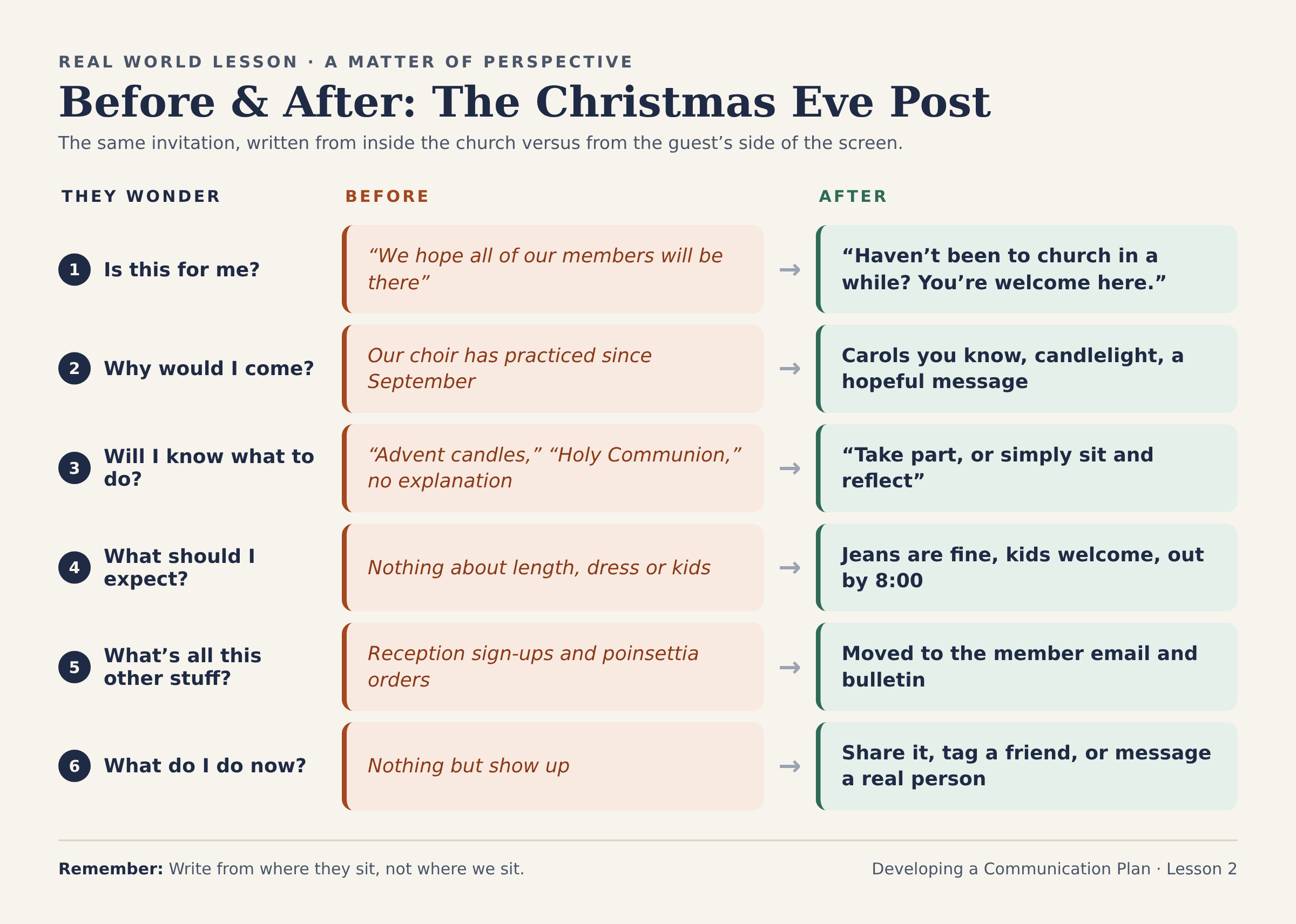
Take it with you: the perspective check
Before anything goes out, whether it’s a post, an email, a sign or an announcement, read it from the other side:
• Whose words come first? Does it open with the church, or with the reader?
• Who is it really for? If it’s for guests, is it written to guests and not to members?
• Effort or experience? Does it describe what we did, or what they will experience?
• What would confuse a guest? Circle every word only insiders know. Explain it or drop it.
• What would they worry about? Length, dress, kids, parking, what to do. Answer it before they have to ask.
• What do we want them to do? Share, reply, register, show up? Make it obvious and easy.
Discussion and practice
1. Find the last three posts your church put on social media. Count the “we/our” words and the “you/your” words in each.
2. Pick one and read it as a specific person: a neighbor who has never been to church, a parent of young kids, someone who stopped coming years ago. What would they wonder?
3. Rewrite the first sentence so it speaks directly to that person.
4. Move anything meant only for members to the place where members will see it.
5. Ask someone from outside your church to read both versions. Which one would they share?