REAL WORLD LESSON · PROGRAMS TO PROCESS
Before & After: The “Ministries” Page
Most churches describe themselves as a list of programs. People don’t experience church that way. They want to know where to start and what comes next. This lesson takes one of the most common pages on a church website and turns it from a list of programs into a process people can follow.
THE REQUEST THAT STARTS IT ALL
“We’re starting a new Thursday night Bible study. Can you add it to the Ministries page?”
So it gets added to the list, right between Theophilus Bible Study and Wednesday Night Bible Study. Here’s what that page looks like.
Before: What the church typically has
A Ministries page that lists every program, alphabetically, with equal weight. The numbers in brackets mark the problems explained below.
gracecommunity.org/ministries
Our Ministries [1]
AWANA — Wednesdays 6:30 PM
Choir — Thursdays 7:00 PM
Dorcas Circle — 2nd Tuesday, 10:00 AM [2]
Koinonia Class — Sundays 9:15 AM, Room 204 [2]
Men’s Ministry — call John
Mission Moms — 1st & 3rd Fridays
Prayer Warriors — Mondays 6:00 AM
Sunday School — Sundays 9:15 AM
Theophilus Bible Study — Tuesdays 7:00 PM [3]
Thursday Night Bible Study — NEW!!! Thursdays 7:00 PM [3]
Wednesday Night Bible Study — Wednesdays 7:00 PM [3]
Women’s Ministry — see bulletin
Youth Group — Sundays 6:00 PM [5]
For more information about any of our ministries, please contact the church office. [6]
Read it like someone who just started attending and wants to get more involved. Where do you start? What is Koinonia? Which of the three Bible studies is for you? And what is there for someone who is brand new? [4]
What goes wrong
[1] No starting point An alphabetical list
It’s organized around the church’s programs, not the person’s journey. Thirteen options with equal weight and no path means most people pick nothing.
[2] Insider names “Dorcas Circle,” “Koinonia Class”
Names that make sense to long-time members tell a newcomer nothing about what happens there or who it’s for.
[3] Programs compete with each other Three Bible studies on three nights
The new Thursday study was simply added to the pile. Overlapping programs split the same people and the same volunteers, and nobody can tell them apart.
[4] A gap no one sees Nothing for new people
Every program assumes you already belong. There is no first step for someone new, and no checkpoint that helps them move from attending to belonging.
[5] Only one way to take part Everything at the building
Every option happens at church, on the church’s schedule. Nothing works for the shift worker, the parent at home with a sick child or the person who isn’t ready to walk in yet.
[6] No personal next step “Contact the church office”
There is no clear action and no person to talk to. The page leaves people to figure it out on their own.
After: How the church could show a process
The same ministries, placed along a path with four stages. The page now answers “Where do I start?” and “What’s next?” The numbers match the problems above, showing how each one was fixed.
gracecommunity.org/next-steps
Find Your Next Step [1]
Wherever you are with God and with Grace, there’s a next step for you. Start where you are.
STEP 1 · EXPLORE
“I’m new, or I’m just checking things out.”
• Sunday Worship: 10:30 AM, in person or online at gracecommunity.org/watch [5]
• Newcomer Lunch: first Sunday of each month after worship. Meet the pastors, ask anything, lunch is on us. [4]
Your next step: Sign up for the next Newcomer Lunch
STEP 2 · CONNECT
“I want to find my people.”
• Small Groups: meet in homes Tuesday, Wednesday and Thursday evenings, plus one online group. Same study, pick the night that fits. [3] [5]
• Men’s Breakfast: one Saturday morning a month
• Women’s Gathering: morning and evening options each month [2]
• Students (grades 6–12): Sundays at 6:00 PM
• Kids (age 3 to grade 5): Wednesdays at 6:30 PM
Your next step: Find a small group near you
STEP 3 · GROW
“I want to go deeper.”
• Next Steps Class: four Sundays at 9:15 AM. What it means to follow Jesus and to be part of Grace. [4]
• Bible Classes for Adults: Sundays at 9:15 AM [2]
• Prayer Team: Monday mornings, in person or by phone
Your next step: Join the Next Steps Class starting January 10
STEP 4 · SERVE
“I want to make a difference.”
• Serve Teams: worship and choir, kids, food pantry, welcome team, and more
Your next step: Take the 2-minute serve survey
Not sure where you fit? Text NEXT to (555) 555-0190 and Pastor [Name] will personally help you find your next step. [6]
Why it’s better
Each fix answers a problem from the “before” page, and each connects to a topic in the Programs to Process course:
[1] A path, not a list (Process over Program · Identify the Stages)
The page is organized around the person’s journey: Explore, Connect, Grow, Serve. Every visitor can find where they are and see what comes next.
[2] Names that say what they are (Change the Language)
“Koinonia Class” becomes “Bible Classes for Adults.” “Dorcas Circle” and “Mission Moms” become part of “Women’s Gathering.” Members may still use the old names, but the public page uses plain words.
[3] Every program has a place, and overlaps are combined (Place the Program · What Goes and What Stays)
Each ministry sits in the stage it serves. The three midweek Bible studies became one small group system: same study, different nights. The new Thursday study became one more small group, not one more listing.
[4] The gap is filled with checkpoints (Find the Gaps · The Big Checkpoints)
Placing programs in stages showed that nothing served new people. A Newcomer Lunch and a Next Steps Class now give them a clear first step and a checkpoint on the way to belonging.
[5] Ways to take part beyond Sunday and the building (Not Only for Sundays · Virtual and In-Person)
Online worship, an online small group and a choice of nights mean people can stay on the path even when their schedule doesn’t match the church’s.
[6] A personal next step at every stage (Making It Personal)
Each stage ends with one clear action, and anyone unsure can text a real person who will help them find their fit.
Behind the scenes: what changed on the page versus in the church
The new page is not just a redesign. To write it, the leadership team had to make real decisions first:
• Agree on the stages of the path (Explore, Connect, Grow, Serve).
• Place every existing program in a stage, and notice which stages were crowded and which were empty.
• Decide what goes and what stays: combine the overlapping Bible studies, and fold smaller groups into larger ones where it made sense.
• Create what was missing: a Newcomer Lunch and a Next Steps Class.
• Name one person to help anyone who isn’t sure where to start.
That’s the heart of moving from programs to process: the website changes because the thinking changed first.
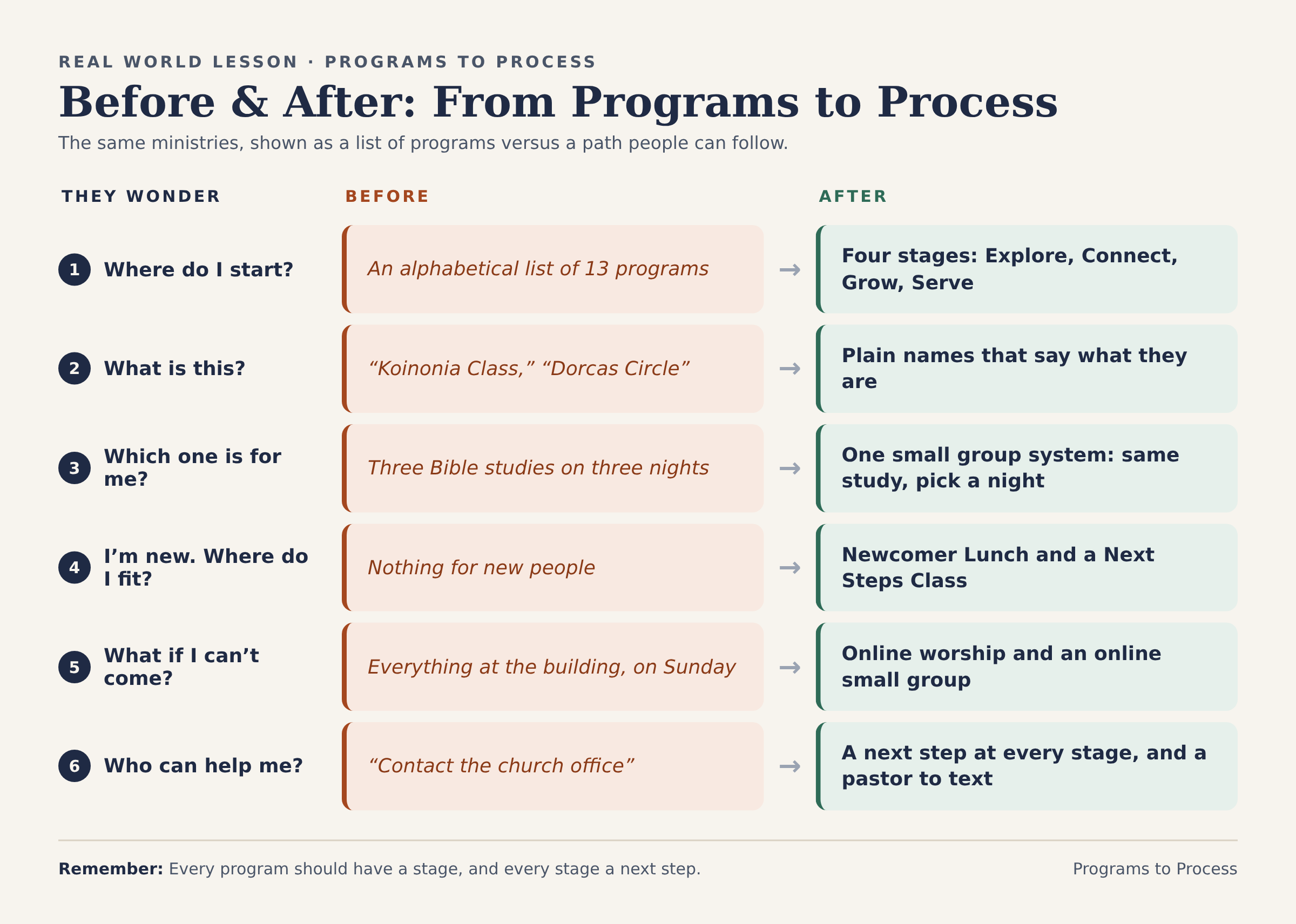
Side by Side
Take it with you: before you add another program
The next time someone asks to add a ministry to the list, ask:
• Which stage does it serve? Explore, Connect, Grow or Serve? If you can’t say, that’s a warning sign.
• Does it overlap with something we already have? Could it be part of an existing ministry instead of a new one?
• Does it fill a gap? Is there a stage where people have nowhere to go?
• What is it called? Would someone new know what it is from the name alone?
• Can people take part beyond Sunday and the building? Is there an online or alternate-time option?
• What’s the next step after it? Where should someone go once they’ve been part of it?
Discussion and practice
1. Print your church’s current Ministries page or bulletin list. Count how many programs it lists.
2. Draw four columns: Explore, Connect, Grow, Serve. Place each program in a column. Which columns are crowded? Which are empty?
3. Circle any programs that overlap. What would it look like to combine them?
4. Underline every insider name. Rewrite each one in plain words a visitor would understand.
5. Write one clear “next step” for each stage, and name the person someone could contact.