REAL WORLD LESSON · 5 TIERS: SOMETIMERS
Before & After: The “We’ve Missed You” Email
Sometimers are people who belong to our church but show up now and then. This lesson looks at one of the most common ways churches try to reach them, why it usually backfires, and how the same message could be written to meet them where they are.
THE REQUEST THAT STARTS IT ALL
“Attendance is down. Send something to everyone who hasn’t been here in six weeks and remind them to come back.”
The goal is good: we don’t want anyone to drift away. Here’s what usually gets sent.
Before: What the church typically sends
This is a mass email sent to everyone who has missed six weeks. The numbers in brackets mark the problems explained below.
From: Grace Community Church Office <office@gracecommunity.org> [1]
To: Undisclosed recipients
Subject: We’ve Missed You!!
Dear Member, [1]
Our records show that you have not attended worship services in the past six weeks. [2] We have missed you! Hebrews 10:25 reminds us not to give up meeting together, as some are in the habit of doing. [3] Church is a family, and a family isn’t complete when members are missing. [4]
Worship is every Sunday at 10:30 AM. We hope to see you back this Sunday! [5]
Blessings,
The Church Office [6]
Read it like someone with a new night-shift job, two kids in travel soccer, or a parent in the hospital. Does this email make you want to come back, or make you feel watched and judged?
What goes wrong
[1] It’s a form letter “Dear Member” from “The Church Office”
A mass email with no real person behind it. It tells the reader they are a name on a list, not someone who is known.
[2] It feels like attendance police “Our records show… six weeks”
Opening with tracking data makes the church sound like it is checking up on them, not caring about them.
[3] Scripture used as a rebuke Hebrews 10:25
A verse used to correct someone you haven’t talked to lands as guilt and shame, and guilt rarely brings people back.
[4] It assumes the worst “A family isn’t complete…”
It assumes they stopped caring. It never considers competing priorities like work, kids or caregiving, or a real obstacle like illness, conflict or a hard season.
[5] Only one option “Sunday at 10:30 AM”
If Sunday morning is the very thing they can’t make right now, the email offers nothing else. It asks them to come to us, instead of meeting them where they are.
[6] No way to really respond “The Church Office”
No question to answer, no person to reply to, and no next step except “show up.” The conversation ends before it starts.
After: How the church could reach out better
The same goal, rewritten as a personal note from someone who knows them. The numbers match the problems above, showing how each one was fixed.
From: Mark Davis <mark@gracecommunity.org> [1]
To: Sarah Thompson
Subject: Thinking of you this week
Hi Sarah,
I was thinking about you and the kids this week and wanted to check in. [2] I know fall gets busy, especially with soccer season and Dan’s new work schedule. [4] How are you all doing? Is there anything we can be praying about for you? [3]
No pressure at all, but in case it helps, here are a few ways to stay connected when Sunday morning doesn’t work: [5]
• Watch or listen anytime: Sunday’s message is online by Monday at gracecommunity.org/watch.
• Wednesday Table, 6:30–7:30 PM: a simple dinner and a short Bible discussion. Kids’ activities included.
• Serve on your schedule: our Saturday food pantry team needs help one morning a month.
If you ever want to grab coffee, I’d love that. Just reply here or text me at (555) 555-0182. [6]
Glad you’re part of our church family,
Mark
Small Group Leader, Grace Community Church
Why it’s better
Each fix answers a problem from the “before” email, and each connects to a topic in the 5 Tiers course:
[1] A real person who knows them (5 Tiers Introduction: Focused Communication Matters)
It comes from Mark, by name, to Sarah, by name. A personal note from someone in their circle carries more weight than any church-wide announcement.
[2] About the person, not the attendance (Sometimers: Introduction)
“I was thinking about you” replaces “Our records show.” The attendance list may be how Mark knew to write, but it is never the message.
[3] An open door instead of a rebuke (Sometimers: Genuine Obstruction)
Asking “How are you?” and “Anything we can pray about?” gives Sarah room to share a real obstacle, like a health issue, a hurt or a hard season, if there is one.
[4] It understands their life (Sometimers: Competing Priorities)
Naming soccer season and a new work schedule shows Mark knows why Sundays are hard right now, without judging it.
[5] Options that fit their week (Sometimers: Meet Where They Are)
An online message, a Wednesday dinner and a Saturday serving team give Sarah ways to stay connected that work with her schedule.
[6] A next step toward growth (Sometimers: Discipling the Sometimer)
Coffee, a reply or a text keeps the relationship going, and the Wednesday group and serving team keep her growing, not just attending.
Side by side
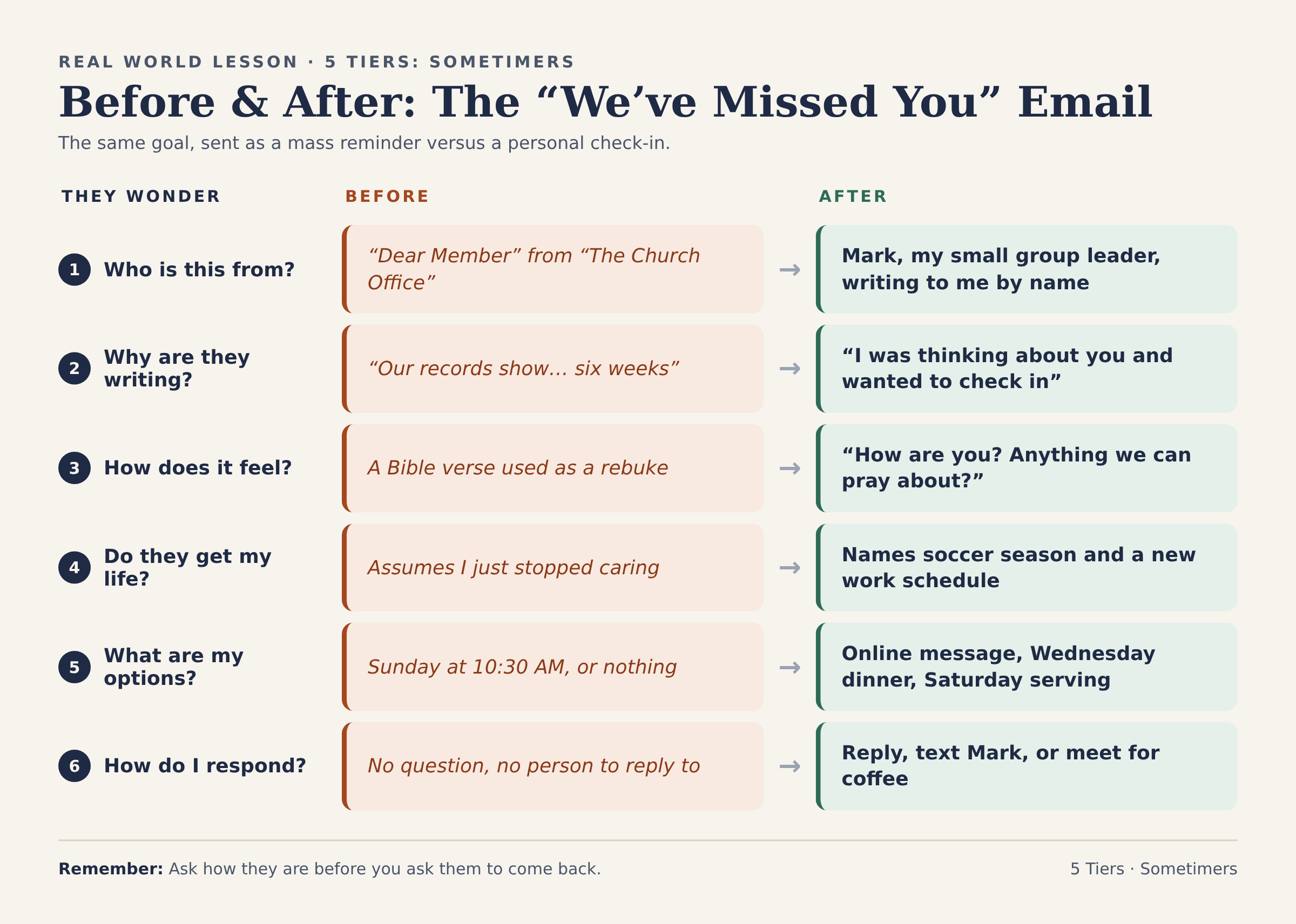
Take it with you: before you reach out to a sometimer
Before any “we’ve missed you” message goes out, by email, text, card or phone call, ask:
• Who should send it? Someone who actually knows them, not “the church office.”
• What am I assuming? Have I left room for busy seasons and real obstacles, not just a lack of commitment?
• Am I asking or telling? Does it ask how they are before it asks them to come back?
• Does it fit their life? Have I offered at least one way to connect besides Sunday morning?
• Is there a next step? Is it easy for them to reply, and is there a way to keep growing?
• Would I want to get this? Read it as if you were the one who had been gone six weeks.
Discussion and practice
1. Think of the last “we miss you” message your church sent, by email, card or from the pulpit. Which of the six problems did it have?
2. Make a list of the most common reasons people in your church become sometimers. Which are competing priorities, and which are real obstacles?