From My Vision to Our Vision
In the last lesson, you started changing your church's language so everyone speaks the language of process. Now it's time to take the next big step: sharing the vision with your leaders and your whole church.
Think back to Lesson 5. There, you wrote a personal vision — the picture you carry in your own heart of what your church could become. That was an important first step. But a vision that lives only in your heart can't move a church. It has to become our vision, shared and owned by the leaders and people who will help make it real.
Casting vision can feel intimidating. Maybe you're not a natural public speaker. Maybe you're worried about pushback, or about saying it wrong. Here's the good news: casting vision isn't about giving one perfect speech. It's about helping people see a picture of a better future, again and again, in a way they can understand and believe in.
In this lesson, we'll walk through how to build the vision together with your leaders, how to share it in the right order, what to include, and some practical tips for doing it well.
Build It Together, Starting With Your Leaders
The biggest mistake leaders make with vision is announcing it before anyone else has helped shape it. When people are handed a finished vision, they tend to evaluate it. When people help build it, they own it.
Scripture puts it plainly: "Without counsel purposes are disappointed: but in the multitude of counsellors they are established" (Proverbs 15:22, KJV). Plans succeed when many wise voices help shape them.
The early church gives us a great example. When a big question about Gentile believers threatened to divide the church, the apostles and elders gathered, prayed, listened to one another, and talked it through. When they finally reached a decision, they could say, "it seemed good to the Holy Ghost, and to us" (Acts 15:28, KJV). Notice that phrase: to the Holy Ghost, and to us. The decision was shaped by prayer and by the whole group together.
Here's how to build your vision together with your leaders:
Share your personal vision as a starting point, not a final answer. Say, "Here's what I've been dreaming about. Help me make it better."
Walk them through the journey. Show your leaders the work you've done in this course: the honest assessment, the stages, the ministry map, the gaps. Let them see what you've seen.
Ask for their dreams too. Invite each leader to share what they'd love to see in your church a few years from now. Look for the common threads.
Pray together. Spend real time seeking God's direction as a team, not just a quick prayer to open the meeting.
Write it together. Shape the final vision as a group so everyone can say, "This is ours."
Share It in Widening Circles
Don't share the vision with everyone at once. Share it in circles, starting small and working outward. Each circle helps refine the vision and becomes a group of champions for the next. Nobody should hear about a big change for the first time from the pulpit if they're someone who will be affected by it.
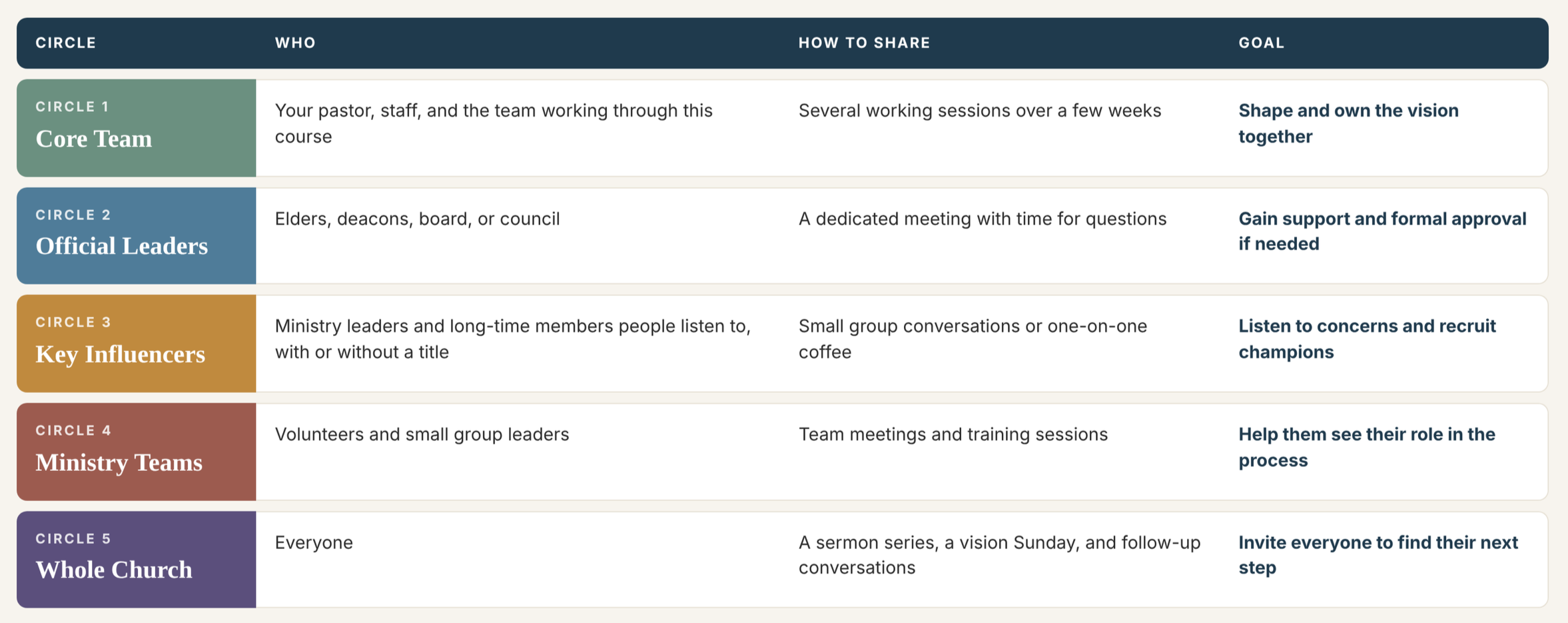
Give each circle time. Moving from Circle 1 to Circle 5 often takes two to six months. That might feel slow, but the time you spend early will save you a lot of conflict later.
What Every Vision Talk Needs
Whether you're sharing with five leaders or five hundred people, a good vision talk answers four simple questions:
Why? (The need.) Why do we need to change? Paint an honest, loving picture of where things are now. Use what you learned in Lesson 6: people getting stuck, guests not coming back, leaders burning out. Help people feel that staying the same isn't really an option.
What? (The picture.) What could our church look like? Describe a clear, hopeful picture of the future, like the one you imagined in Lesson 5. Help people see it.
How? (The path.) How will we get there? Share your stages and process in simple terms. People need to know there's a real plan, not just a dream.
You? (The invitation.) What's my part? Every vision talk should end with a clear, personal next step for the people listening.
Write a Simple Vision Statement
It also helps to boil your vision down into one memorable sentence that anyone can repeat. Here are a few tips:
Keep it short. If people can't remember it, they can't repeat it. Aim for 15 words or fewer.
Make it about people, not programs. Focus on what happens in people's lives.
Include movement. Use words that show growth and direction.
Use your own stage names if they fit.
Here are a few examples to spark ideas:
"Helping every person take their next step toward Jesus."
"Connecting people to God, growing them in faith, and sending them to serve."
"From guests to family, from family to followers, from followers to leaders."
Tips for Sharing the Vision Well
Here are some practical tips that will help your vision land and stick:
Tell stories. People remember stories far longer than statistics. Share the story of one real person who got stuck in the old way, or who took a step in a new ministry. (Get their permission first!)
Honor the past. Thank the people who built your church and the ministries that served it well. The vision isn't saying the past was wrong. It's building on the foundation they laid.
Keep it simple. If you can't explain the vision to a 12-year-old, it's too complicated. Use plain words and your shared glossary from Lesson 16.
Use visuals. A simple graphic of your stages or a one-page pathway guide helps people see the process at a glance.
Say it again and again. Vision leaks. People forget, get distracted, and drift back to old habits. Plan to share the vision regularly: in sermons, announcements, leader meetings, and everyday conversations. When you're tired of saying it, people are just starting to hear it.
Use many voices. Don't let the pastor be the only one talking about it. Have ministry leaders, small group leaders, and people whose lives have changed share it too.
Use many channels. Share it from the pulpit, in small groups, in newsletters, on social media, on your website, and one-on-one.
Show progress. Celebrate early wins and share them often. Nothing builds belief in a vision like seeing it come true.
Handling Questions and Pushback
No matter how well you share the vision, some people will have questions, and some will push back. That's normal and even healthy. Questions often mean people are taking the vision seriously. Here's how to respond well:
Listen first. Let people finish. Ask, "Can you tell me more about that?" Many concerns soften once people feel heard.
Look for the fear underneath. Pushback is often about loss: "Will my ministry go away?" "Will I still have a place here?" Speak to the fear, not just the words.
Don't take it personally. People who push back usually love the church. That's why they care so much.
Be honest about what you don't know. It's okay to say, "Good question. We haven't figured that out yet, but we will, and we'd love your help."
Invite critics into the process. Some of your strongest champions may start as your toughest critics. Ask them to help solve the problem they're worried about.
Prepare answers to common questions. Create a short list of questions you expect, like "Are we getting rid of my favorite ministry?" or "Why do we need to change?" Write simple, honest answers your leaders can share.
Stay patient and kind. As Paul wrote, "the servant of the Lord must not strive; but be gentle unto all men, apt to teach, patient" (2 Timothy 2:24, KJV).
Action Steps
Before you move on to Lesson 18, work through these on your own or with your team:
Revisit your personal vision. Reread the vision you wrote in Lesson 5 and update it with everything you've learned since.
Read Acts 15:1–31. Notice how the early church leaders worked through a big decision together. Write down what you can learn from their process.
Hold vision-building sessions with your core team. Share your personal vision, ask for their dreams, and pray together. Plan at least two or three sessions.
Write a shared vision statement. As a team, write one memorable sentence of 15 words or fewer.
Map your circles. Write down the names of the people in each circle and set target dates for sharing with each one.
Build your vision talk. Outline a talk that answers Why, What, How, and You. Include at least one real story.
Create a question-and-answer sheet. List the ten questions you expect people to ask and write simple, honest answers.
Plan the repetition. Write down at least five ways and places you'll share the vision over the next six months.
Pray for open hearts. Pray by name for the leaders and influencers in your first circles.
A shared vision turns a plan into a movement. See you in Lesson 18!