Winning Hearts, Not Just Votes
In the last lesson, you learned how to build a shared vision and share it in widening circles. Now we come to one of the most important — and most challenging — parts of the whole journey: the buy-in.
Here's the reality. You can have a great process, a clear vision, and even an official vote of approval, and still find that nothing really changes. Why? Because people haven't truly bought in. They may go along with it on the surface, but in their hearts they're still thinking the old way.
This is especially true for people who have been in church for a long time. Many of your most faithful members have spent their whole lives in program churches. Programs are how they came to faith, how they raised their kids, how they served, and how they measured a good church. For them, programs aren't just a way of doing ministry. They're woven into some of their most precious memories.
So buy-in isn't about winning an argument. It's about winning hearts. In this lesson, we'll look at why people resist, how buy-in actually happens, and practical ways to help even the most program-minded people embrace the process and become some of its strongest champions.
Why People Resist
Before you can help people buy in, you need to understand why they hold back. Most resistance isn't really about the idea of process at all. It's about something deeper. Here are some of the most common fears hiding underneath:
Fear of loss. "Will my favorite ministry go away?" For many people, a ministry is where their closest friends are and where they've felt most useful.
Fear of being forgotten. "Is the church moving on without me?" Long-time members can worry that change means their years of service no longer matter.
Fear that the past was wrong. "Are you saying we did it wrong all these years?" When people hear about change, they can hear criticism of everything they've built.
Fear of the unknown. "What will this actually look like?" Programs are familiar. A process can feel abstract and uncertain.
Fear of being left behind. "I don't understand this new language." When new words and ideas show up, some people quietly feel like outsiders in their own church.
Weariness. "We've tried new things before." Some people have watched past initiatives come and go, and they're not eager to invest in another one.
When you hear pushback, listen for these fears. Respond to the fear, not just the words, and you'll find many people are far more open than they first appeared.
Buy-In Happens in Stages
Nobody goes from "I've never heard of this" to "I'm all in!" in one step. Buy-in is a process too. People usually move through four stages, and each stage needs something different from you.
Here's the key insight: you can't skip stages. If someone is still at Aware, pushing them to Owning will only create more resistance. Meet each person where they are and help them take their next step. Sound familiar? It's the same principle you're using for spiritual growth. You're simply applying the process to the change itself.
Five Keys to Winning Hearts
The early church faced its own buy-in challenge in Acts 6. A group of believers complained that their widows were being overlooked in the daily food distribution. The apostles didn't ignore the complaint or defend the old way. They listened, gathered everyone together, explained a new plan, and invited the people to help choose the leaders who would carry it out. And Scripture says, "the saying pleased the whole multitude" (Acts 6:5, KJV). That's buy-in. Here are five keys that follow the same pattern:
1. Honor the past. Before you talk about what's next, celebrate what God has already done. Thank the people who built your church's ministries. Tell stories of lives changed through them. Make it clear: "We're not saying the past was wrong. We're building on the foundation you laid."
2. Connect to what they already value. Long-time members almost always care deeply about the things a process church cares about. They want their grandkids to follow Jesus. They want new people to feel welcome. They want the church to thrive after they're gone. Show them how the process helps accomplish the very things they've been praying for for years.
3. Involve them early. People support what they help create. Ask long-time members for their input. Invite them into conversations before decisions are final. Ask, "What would you hate to lose? What do you hope for?" You'll gain wisdom and buy-in at the same time.
4. Show, don't just tell. Abstract ideas are hard to buy into. Real results are easy. Start with a few small pilots, then share stories of people taking next steps. One story of a young family finding their way into a group can do more than a dozen explanations.
5. Give it time. Some people need to watch for a while before they'll trust something new. That's okay. Be patient, keep loving them, and keep telling the story. Many of your slowest adopters will become your most loyal champions once they see the fruit.
Give Long-Time Members a Vital Role
Here's one of the most important truths in this whole lesson: your long-time members aren't obstacles to the process. They may be your greatest asset.
Think about Caleb. At 85 years old, he didn't sit on the sidelines while the younger generation took the Promised Land. He said, "As yet I am as strong this day as I was in the day that Moses sent me… Now therefore give me this mountain" (Joshua 14:11–12, KJV). The psalmist prayed something similar: "Now also when I am old and greyheaded, O God, forsake me not; until I have shewed thy strength unto this generation" (Psalm 71:18, KJV).
Many of your long-time members have that same heart. They just need to see where they fit. And a process church needs exactly what they have: years of faithfulness, deep knowledge of Scripture, prayer, wisdom, and life experience. Paul told Titus that the older women should "teach the young women" (Titus 2:3–4, KJV). In a process church, that's not an afterthought. It's built right into the later stages of the pathway.
Here are some meaningful roles you can offer:
Mentors and guides. Pair them with newer believers to walk alongside them through the stages.
Prayer champions. Ask them to pray by name for people at each stage of the process.
Storytellers. Invite them to share how God has worked in their lives and in the church's history.
Welcome hosts. Their warmth and stability can make guests feel at home in the Connect stage.
Advisors. Include a few respected long-time members on the team guiding the change.
When long-time members see that the process gives them a bigger role, not a smaller one, buy-in often follows naturally.
Common Objections and How to Respond
You'll hear some of the same objections again and again. Here are a few of the most common, along with gentle, honest ways to respond. Use your own words, and always listen first.
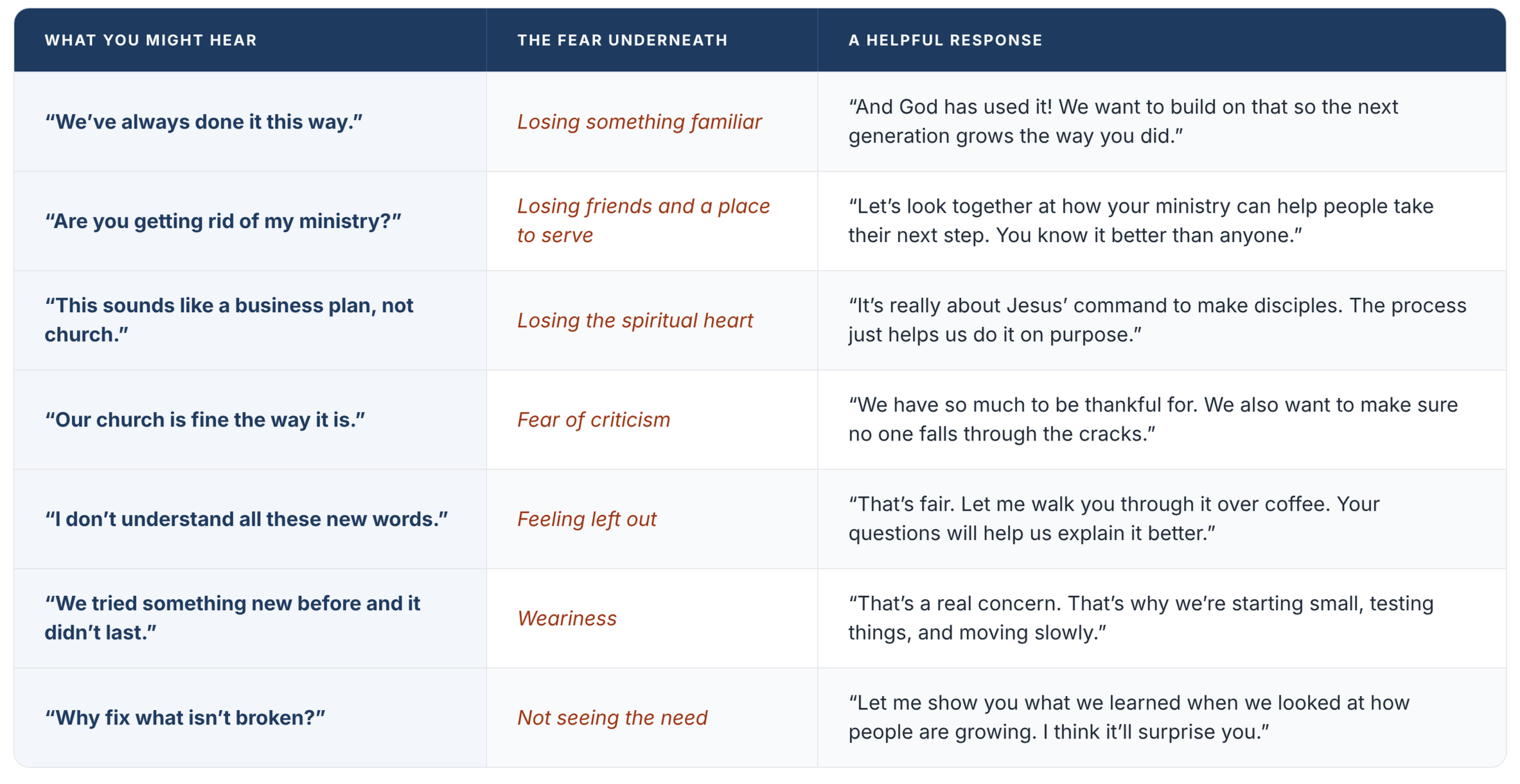
Remember, the goal isn't to win the debate. The goal is to keep the relationship strong and the door open. Paul said, "Let your speech be alway with grace, seasoned with salt, that ye may know how ye ought to answer every man" (Colossians 4:6, KJV).
Action Steps
Before you move on to the next lesson, work through these on your own or with your team:
Read Acts 6:1–7 and Joshua 14:6–14. Write down what you learn about listening to concerns and honoring faithful, long-time servants.
List your key long-time members. Write down 10 to 15 long-time members whose support will matter most. Next to each name, note which buy-in stage you think they're in.
Have three listening conversations. Sit down with three long-time members. Ask what they love about the church, what they'd hate to lose, and what they hope for. Mostly listen.
Plan a "Celebrate the Past" moment. Plan a Sunday, dinner, or gathering to thank the people who built your church's ministries and share stories of what God has done.
Offer three meaningful roles. Personally invite at least three long-time members into roles like mentor, prayer champion, or advisor.
Prepare your responses. Using the objections table, write your own responses to the five objections you expect to hear most.
Collect one success story. Find one story of someone taking a next step through a new or transformed ministry, and get permission to share it.
Pray for soft hearts — including your own. Ask God to give you patience, humility, and love for those who are slow to change.
Buy-in takes time, but every heart you win becomes a voice that helps win the next. See you in the next lesson!