
Welcome to the Development Section
Take a moment to look at what you've built. In Section 1, you caught the vision. In Section 2, you laid the foundation: you took an honest look at your church, named your stages of growth, mapped your ministries, made hard decisions about what to keep, transform, and retire, and found the gaps. That's a lot of solid ground.
Now we move to development. This section is all about people — how they actually grow, move, and mature along the path you've built. A path on paper is a great start. But a path only matters if people are walking it.
In this lesson, we'll focus on flow: helping people move naturally from one stage to the next. And we'll add checkpoints along the way — clear markers that help people (and your leaders) know where they are and when they're ready for their next step.
The early church gives us a beautiful picture of flow. On the day of Pentecost, people heard the gospel and "gladly received his word" and "were baptized." Then "they continued stedfastly in the apostles' doctrine and fellowship, and in breaking of bread, and in prayers" (Acts 2:41–42, KJV). Notice the movement: they heard, they believed, they were baptized, and they kept going. Each step led to the next. Nobody had to wonder what came after baptism. The path was clear, and the church walked it together. That's what we're building.
What Moves People Forward
Here's something important to understand: people rarely move to the next stage on their own. Most of us need a little help. In churches where people flow well along the path, three things are almost always in place at every transition.
1. A clear invitation. People need to be asked. A sign-up sheet in the lobby is fine, but a personal invitation is far more powerful. "I think you'd love our newcomers' lunch — would you come with me?" goes a lot further than an announcement. Every stage should end with a specific, personal invitation into the next one.
2. A guide who walks alongside. Think about Barnabas. When Saul came to Jerusalem after his conversion, the disciples were afraid of him. "But Barnabas took him, and brought him to the apostles" (Acts 9:27, KJV). Later, Barnabas went looking for Saul and brought him to Antioch to serve (Acts 11:25–26). Saul needed someone to open the door and walk through it with him. So do the people in your church. Every transition should have a Barnabas — a group leader, mentor, or friend who personally helps someone take their next step.
3. A moment of celebration. When someone takes a step, celebrate it! A baptism, finishing a class, joining a team, or leading a group for the first time — these are big deals. Celebration tells people their growth matters, and it encourages others to take the same step.
As you design your checkpoints in this lesson, make sure each one includes all three: an invitation, a guide, and a celebration.
What Is a Checkpoint?
A checkpoint is a simple, visible milestone that shows a person has grown through one stage and is ready to step into the next. Think of it like a trail marker on a hiking path. It tells you how far you've come and points you toward what's ahead.
Good checkpoints have four parts:
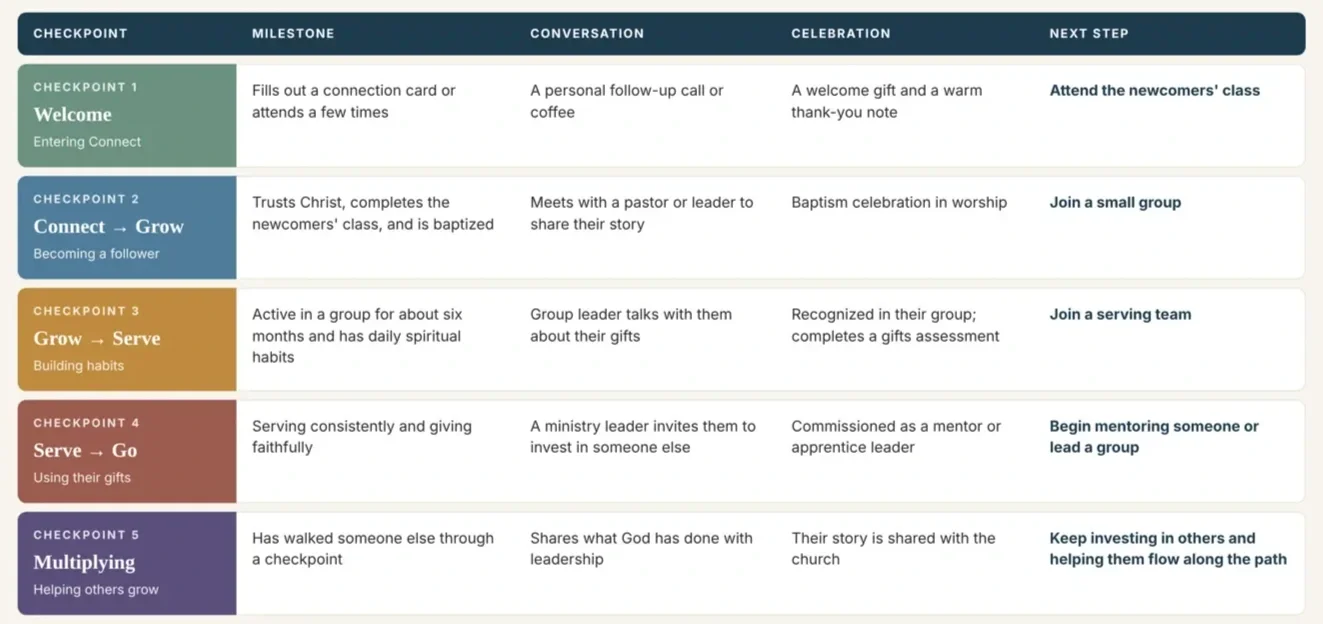
The milestone: a specific thing a person has done or experienced (for example, "completed the newcomers' class").
The conversation: a short, personal check-in with a leader to talk about how they're growing and what's next.
The celebration: a way to recognize the step, whether it's public or personal.
The next step: a clear invitation into the next stage.
Here's what checkpoints might look like using the Connect, Grow, Serve, Go stages from earlier lessons. You'll have one checkpoint at each transition, plus one at the very beginning and one that sends people back around to help others.
Designing Your Own Checkpoints
Now it's your turn. Pull out your stage chart from Lesson 7, especially the marks of maturity you wrote for each stage. Those marks are the raw material for your checkpoints. Then work through these steps:
Name your transitions. List every point where a person moves from one stage to the next, plus a starting checkpoint and a multiplying checkpoint.
Choose one or two milestones for each. Pick the clearest signs that someone is ready to move on. Keep it simple. One or two milestones is better than a long checklist.
Decide who has the conversation. Name the role (not just a person) responsible for each check-in: a greeter, group leader, team leader, or pastor.
Plan the celebration. Decide how you'll mark each step. Some can be public, like a baptism. Others can be personal, like a handwritten note.
Connect the next step. Make sure each checkpoint points to a specific ministry from your updated map.
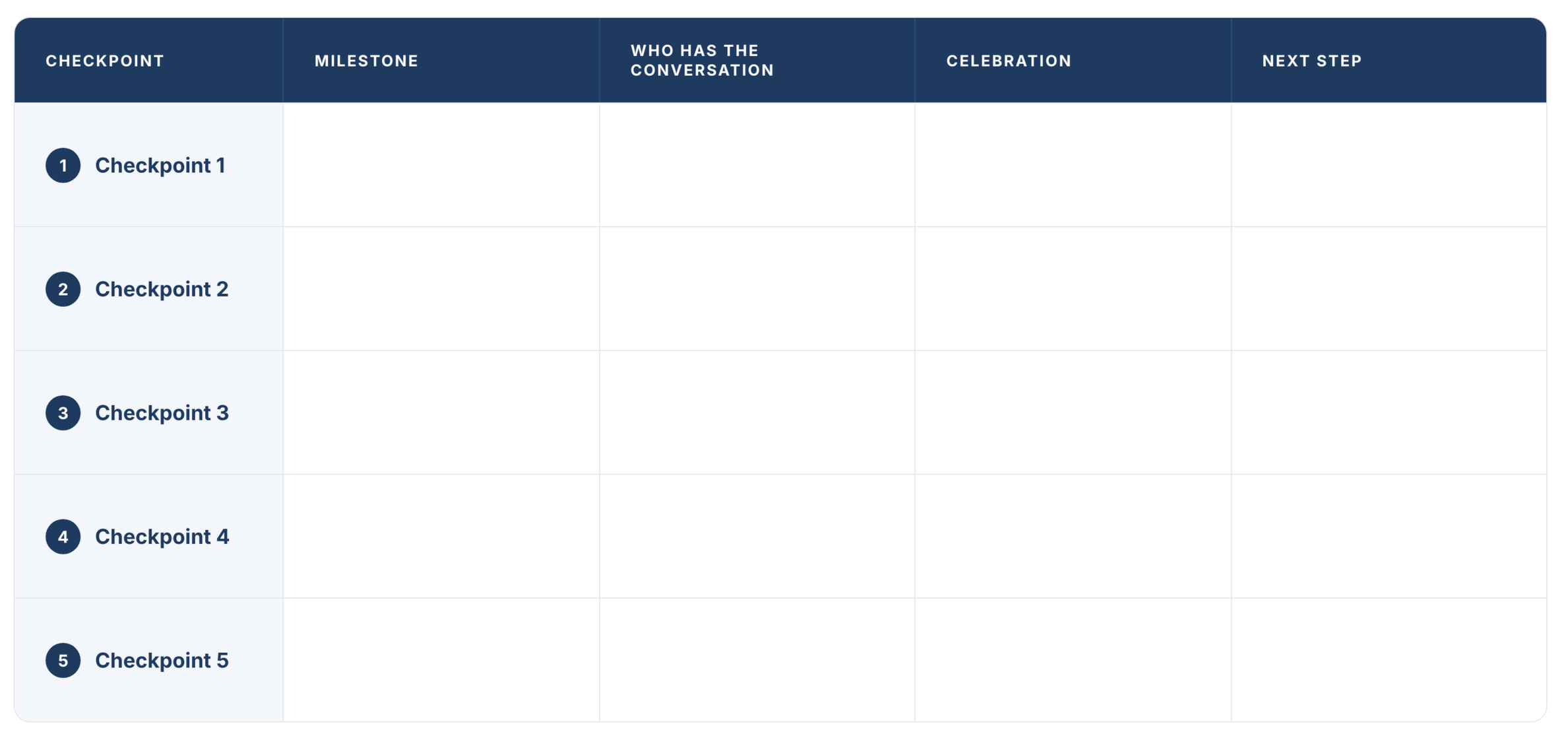
Use this worksheet to build them:
As you fill it in, look back at the gaps you found in Lesson 10. If a transition has no ministry to point to, that's one of your bridge gaps, and it should stay near the top of your list.
Keeping Checkpoints Full of Grace
A word of caution. Checkpoints are meant to be trail markers, not toll booths. The goal is to encourage people, not to make them feel graded or held back. Here are a few ways to keep them healthy:
They're guides, not gates. Nobody has to "pass" a checkpoint to be loved or welcomed. A person can serve before they've finished a class, and that's okay.
Growth isn't always a straight line. People sometimes move back a stage during a hard season. Meet them there with grace, not guilt.
Focus on the person, not the paperwork. The conversation matters far more than the checkbox.
Go at their pace. Some people will move through a stage in months. Others will take years. Both are fine.
As Paul said, the aim is to keep pressing forward: "I press toward the mark for the prize of the high calling of God in Christ Jesus" (Philippians 3:14, KJV). Checkpoints simply help people see the mark.
Tracking Flow Simply
You don't need fancy software to track how people are flowing. Start with something simple:
A shared spreadsheet or church database field that notes each person's current stage and the last checkpoint they reached.
A monthly leader huddle where group and team leaders share who took a step and who might need some encouragement.
A few key numbers you review every quarter, like how many people reached each checkpoint and how long people tend to stay in each stage.
When you track flow, you'll start to see where people are moving well and where they're getting stuck. That tells you exactly where to focus next.
Action Steps
Before you move on to Lesson 12, work through these on your own or with your team:
Read Acts 2:37–47. List every step of movement you see in the early church, from hearing the gospel to daily life together.
Build your checkpoint worksheet. Fill in a milestone, conversation, celebration, and next step for each of your checkpoints.
Assign the guides. For each checkpoint, name the role responsible for the conversation. Then write down the names of people who could fill those roles today.
Write your invitations. For each transition, write a one- or two-sentence personal invitation leaders can use to invite someone to their next step.
Plan one celebration. Pick one checkpoint and plan how you'll celebrate it in the next month or two.
Set up simple tracking. Choose how you'll record each person's stage and checkpoints, and schedule your first leader huddle.
Be someone's Barnabas. Think of one person who's ready for a next step. Personally invite them this week and offer to walk with them.
You're helping your church move from a map on paper to people on the move. See you in Lesson 12!
