Knowing the State of Your Flock
You've built your process, shared the vision, and worked hard to win hearts. Now we need to make sure the process keeps working long after the excitement of the launch fades. That's where ongoing tracking comes in.
Back in Lesson 15, we talked about the big idea behind measurement: you can't measure the heart, but you can measure change. In this lesson, we'll get practical about how to actually do that inside a real church, week after week and year after year. We'll look at how to track each person's growth and how to tell whether the process itself is succeeding.
Some people feel uneasy about tracking in a church. It can sound cold or corporate. But Scripture tells shepherds to pay close attention: "Be thou diligent to know the state of thy flocks, and look well to thy herds" (Proverbs 27:23, KJV). A good shepherd knows his sheep. He notices when one is missing, sick, or ready for greener pasture.
The early church paid attention too. Luke recorded that "the same day there were added unto them about three thousand souls" (Acts 2:41, KJV), and that "the Lord added to the church daily such as should be saved" (Acts 2:47, KJV). They noticed what God was doing and wrote it down. That's what good tracking is: paying attention to people so we can care for them well and celebrate what God is doing.
Two Questions to Track
Ongoing tracking answers two different questions. It's important to keep them separate, because they tell you different things.
Question 1: Are people growing? This is about individuals. Is Sarah moving from Grow to Serve? Has the Johnson family reached their first checkpoint? Is anyone stuck? This question helps you care for each person and help them take their next step.
Question 2: Is the process working? This is about the system. Are people moving through the stages at a healthy pace? Which ministries are helping people take next steps, and which aren't? Where are people getting stuck? This question helps you improve the process itself.
You need both. If you only track individuals, you may miss a bottleneck that's affecting dozens of people. If you only track the system, you may lose sight of the person in front of you. A healthy process church keeps one eye on the person and one eye on the path.
Setting Up a Simple Tracking System
You don't need expensive software to get started. What matters most is that you track the same things consistently and that the right people keep the information up to date.
Choose Your Tool
Small churches (under 100 people) can start with a simple shared spreadsheet.
Medium and larger churches will usually want to use their church management software. Most church databases let you add custom fields for things like stage and checkpoints.
Whatever you choose, keep it in one place. Information spread across notebooks, emails, and memories will get lost.
Decide What to Record for Each Person
Keep it short. Every field you add is one more thing someone has to keep up with. Here's a good starting list:
Decide Who Records What
The people closest to each person should do most of the updating. Group leaders, team leaders, and guides know who's growing and who's stuck. Give them a simple way to report, like a short monthly form or a quick update during a leader huddle, and have one staff member or volunteer enter it into your system.
Measuring the Success of the Process
Once you're tracking individuals, you can add up the information to see how well the process is working. These measures focus on movement, because movement is the whole point of a process. You don't need to track all of them. Pick four or five that fit your church best.
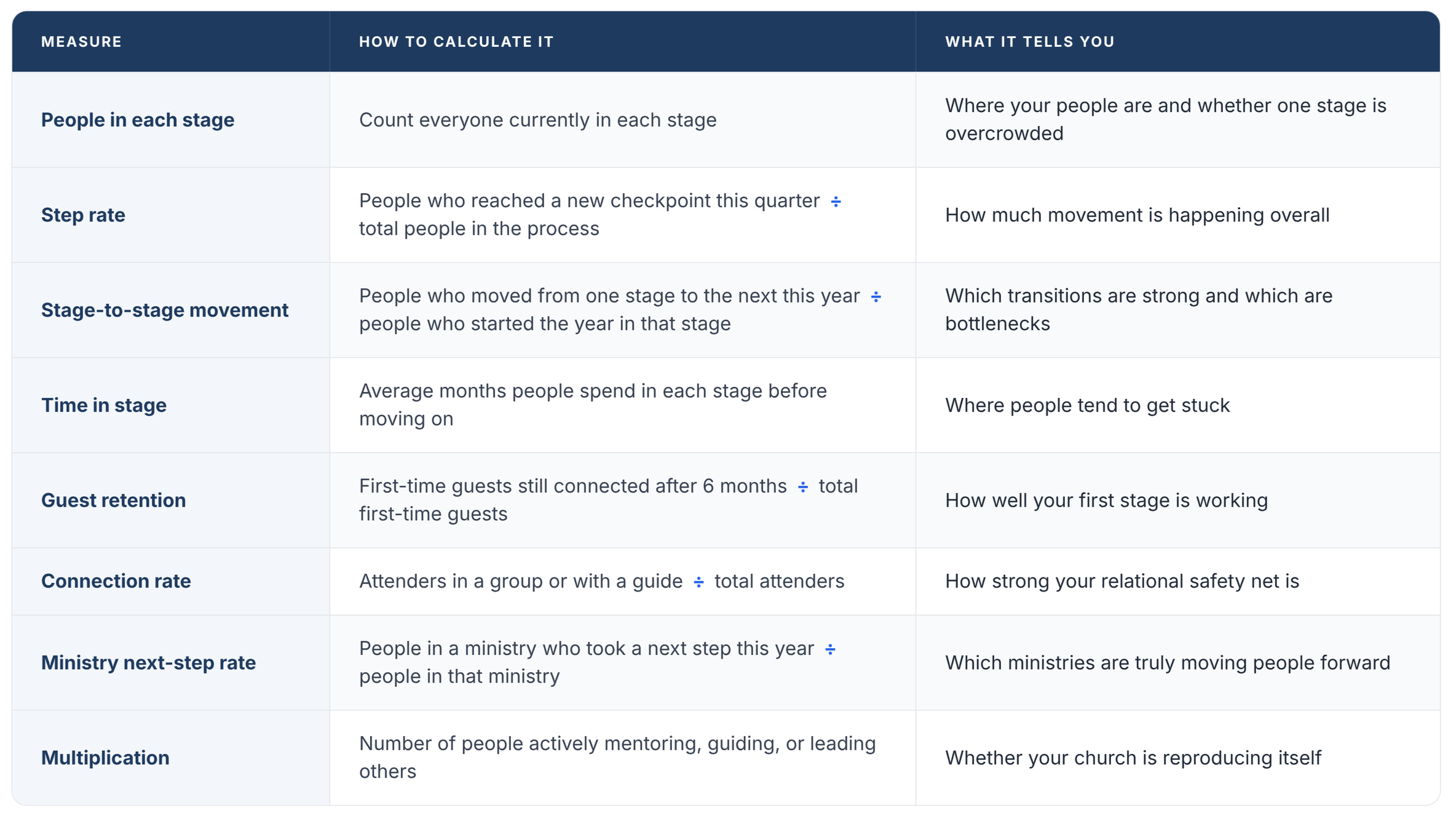
Two tips for reading these numbers:
Watch the trend, not one snapshot. A single quarter can be up or down for lots of reasons. Look at how each number changes over a year or more.
Let the numbers point you to people. When a number looks off, go find out why. If time in the Grow stage is getting longer, talk to some of the people in that stage and listen. The numbers tell you where to look. People tell you what's really going on.
A Tracking Rhythm
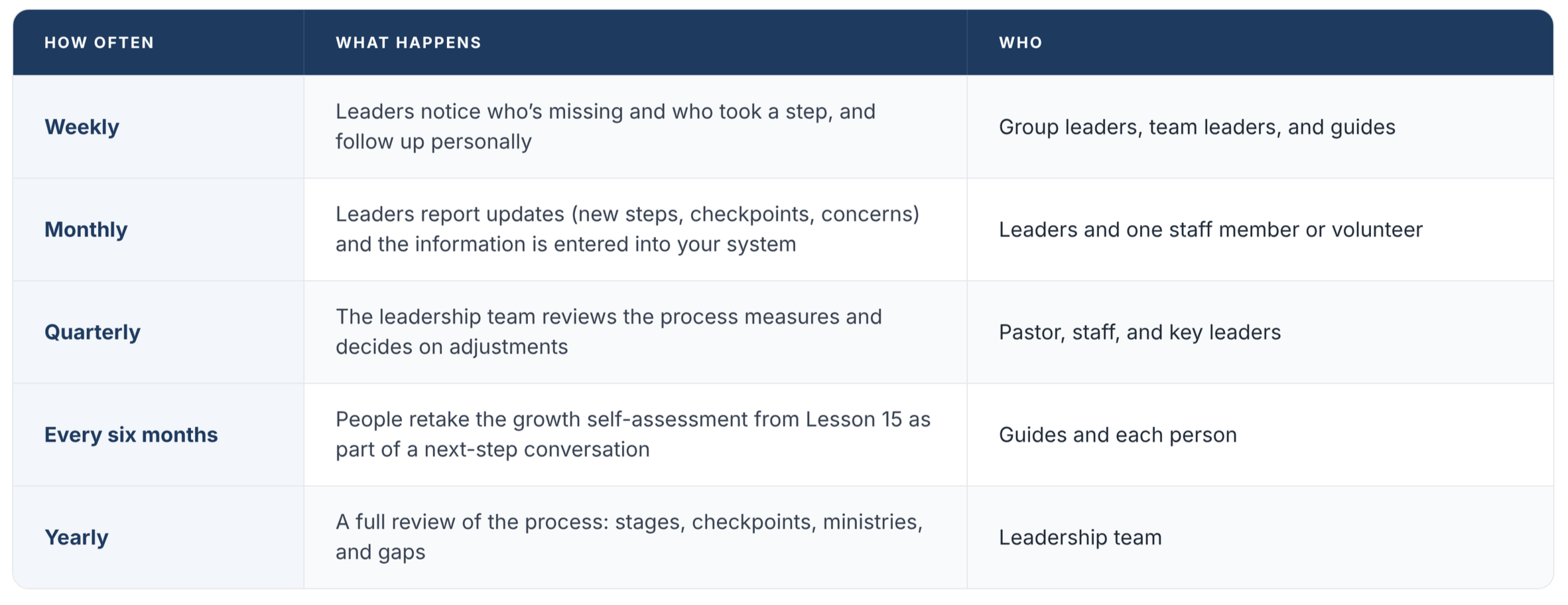
Tracking only works if it happens regularly. Build it into your church's normal rhythm so it doesn't depend on someone remembering. Here's a simple rhythm you can adapt:
A Simple Quarterly Review Meeting
The quarterly review is where tracking turns into action. Plan about 90 minutes and follow this agenda:
Celebrate (15 minutes). Share stories of people who took steps this quarter. Always start here.
Review the numbers (20 minutes). Look at your four or five key measures and compare them to last quarter and last year.
Find the bottleneck (20 minutes). Ask, "Where are people getting stuck the most right now?"
Listen to the stories behind it (15 minutes). Share what leaders are hearing from people in that stage.
Decide one or two adjustments (15 minutes). Choose a small number of changes to try next quarter, and name who's responsible.
Pray (5 minutes). Pray for the people behind the numbers, especially those who are stuck.
Keeping Tracking Simple and Healthy
Tracking can quietly become a burden, or worse, a way of treating people like numbers. Keep it healthy with these guidelines:
Start small. Track three to five things well rather than twenty things poorly. You can always add more later.
Make it easy for leaders. If reporting takes more than five minutes a month, simplify it. Busy volunteers won't keep up with a complicated system.
Protect people's privacy. Personal notes and assessments should be seen only by the person's guide and the staff who need them. Share totals with the church, never individuals' details.
Use numbers to serve people, not judge them. Every number represents a real person God loves. Never use tracking to shame a leader or a ministry.
Keep the purpose in front of everyone. Remind your leaders often why you track: so no one falls through the cracks, and so you can celebrate what God is doing.
Remember who gives the growth. As Jesus said, "Herein is my Father glorified, that ye bear much fruit" (John 15:8, KJV). We track the fruit, but the glory belongs to Him.
Action Steps
Before you move on to the next lesson, work through these on your own or with your team:
Read Proverbs 27:23–27 and John 10:1–14. Reflect on what it means to know and care for the people God has given you.
Choose your tool. Decide whether you'll use a spreadsheet or your church management software, and set it up with the fields from this lesson.
Enter your starting point. Record each person's current stage and last checkpoint as best you can. This becomes your baseline.
Assign who updates what. Write down which leaders are responsible for updating which people, and create a simple monthly reporting form.
Pick your process measures. Choose four or five measures from the table to track every quarter.
Put the rhythm on the calendar. Schedule monthly leader updates, your first quarterly review meeting, and your yearly process review.
Hold your first quarterly review. Use the agenda in this lesson, and start with stories.
Write a privacy guideline. Decide who can see personal information and how it will be protected, and share it with your leaders.
Good tracking keeps your process healthy, your leaders focused, and your people cared for. See you in the next lesson!